Monday, December 17, 2007

THE BOGUS EFFECT

Over the years many magicians have tried to replicate The Berglas Effect, an impossible version of the card at any number. The dream effect is that someone thinks of a card. Another person thinks of a number. And when the number is dealt to, lo and behold, there is the thought of card. It sounds simple enough but as a card problem it is a hard one to crack, especially if you are looking for a routine you can use under everyday working conditions rather than, say, a one-off television show.

There are many versions of The Berglas Effect on the market, also known by the acronym ACAAN (Any Card At Any Number), all claiming to be miracles. But the hype for each new release is quickly followed by disappointment as buyers learn that the cleverest part of the trick was the advertising.

Which is why I prefer to call this family of tricks The Bogus Effect. Let’s imagine the advert for this particular version:

EFFECT

A spectator merely thinks of a card. He tells no one. He does not write it down.

Another spectator thinks of any number from 1 to 52. No force. Again nothing is written down. The deck is shuffled and placed on the table. The performer never touches the deck from this moment. For the very first time the number is revealed. The chosen number is counted down to. Only then is the thought of card named. And yes it is the very card at the thought of number. Totally self-working. Resets instantly. The thought of card is always at the called number. The rest of the cards can be freely shown. The spectator deals the cards. The performer doesn’t need to know the number until it is reached. Fifty bucks!

METHOD

You’ve had the hype. Now for the disappointment. That’s because the trick depends on the use of a Svengali Deck. However, there are one or two things about the routine that not only make it effective but should throw off those who already know the Svengali. The first is that you actually use a Reverse Svengali. This is a deck in which all the force cards are long and the indifferent cards are short. I bought mine, in Bicycle Poker Size, from the Bond Agency.

If you’ve handled a Svengali deck before you’ll know that you can shuffle it, riffle it and spread it to demonstrate that it’s made up of different cards. Best of all because this is a Reverse Svengali you can riffle spread the deck face-up across the table to show all the cards are different. In short, there’s no reason for the spectators to imagine that this is anything but an ordinary deck. With that in mind, let’s assume that the spectators are convinced you are using a regular deck and get down to the handling.

Step 1: With the deck face-down in the left hand cut it so that an indifferent card is on the face. To do this as the right hand comes over the deck to make the cut, the right thumb presses down on the inner short end to break the deck open. Make the cut at the break. You should now have an indifferent card on the face of the deck.

Step 2: Tell one of the spectators that you want him to think of a card. Demonstrate how you want him to think of a card as follows. Cut the deck, again secretly pressing down on the inner short end with the right thumb. Lift the upper half of the deck towards you and look at the face card as you say, “I just want you to cut the deck and take a look at the card you’ve cut to. Remember it. That’s important.”

Replace the cut portion letting the spectators get a glimpse of the card you cut to. Now demonstrate the cut again. And again you secretly use the right thumb to open up the inner end of the deck so that you cut to another indifferent card. Show the card you have cut to, saying, “But don’t show to anyone else the card. You will be the only person that knows the name of the card you are thinking of. Got that?”

Replace the cut portion of the deck, square the cards, and hand the deck to the spectator. You could, if you feel it necessary, throw in another shuffle and cut here to apparently mix the cards.

Step 3: They’ve just seen you cut to two completely different cards. And now the spectator cuts the cards for himself. Supervise him so that he makes the cut in the proper manner, thumb at the inner end and fingers at the outer end. If he makes the cut normally (and not the way you did) he will be looking at a force card on the face of the upper packet. Keep an eye on him when he does this but at the same time try to appear indifferent to the process as you turn to a second spectator and ask him to think of a number between 1 and 52.

Then turn back to the first spectator and make sure he replaces the cards he has in hand. Take the deck from him and give it an overhand shuffle of the type that doesn’t alter the short/long distribution of the cards.

Step 4: As you shuffle the cards say, “Now not only does no one know the name of the card you are thinking of. But not even you know where it is.” Finish the shuffle so that there is an indifferent card on the face and place the deck face-down on the table. By the way, the only reason I advise you to keep an indifferent card on the face of the deck is to avoid showing a force card if you accidentally flash the face card.

Step 5: Appear to concentrate a little and then say, “Now I’m not really getting much of a sense of the card." Then turn to the spectator who is thinking of a number and add, "But am I right in saying that you’re thinking of an odd number?” This is a 50/50 shot. Either the spectator will say you are right or he will tell you that you’re wrong. But it sets you up for what you have to do next.

The situation is that the force cards are lying at every odd position in the deck. If he is thinking of an odd number you are all set to go. If not, quickly say, “Doesn’t matter. Keep the number to yourself for the moment because I’m not going to do this you are.”

“I don’t want you to think that what you are about to see has anything to do with the way I shuffled the cards. So will you please give the cards a cut.” You motion to him to make a single cut by lifting up the top half of the deck (fingers and thumb at the short ends), placing it aside and then putting the lower half on top of it. Because he will always cut a short card (indifferent card) to the top of the deck it means he has unwittingly placed all the force cards at an even number. Clever eh?

This strategy of getting the spectator to adjust the deck is one I picked up from David Berglas and is described in The Mind and Magic of David Berglas. I call it The Berglas Cut because it is so very useful in effects of this type.

Step 6: You recap the situation. “No one knows the number you are thinking of. And no one knows the card you have in your mind. Let’s see if we’ve been lucky. What is your number?” Whatever number the second spectator calls out have him deal number of cards from the deck into a face-down pile on the table. As he deals stop him one card short of the chosen number.

You have to be careful that he doesn’t expose the faces of the cards as he deals. If he is standing and too far from the table, I suggest you do it yourself but make it as clean and open as possible.

When you get to the selected number slide that card face-down onto the table. Pick up the next card and throw it face-up onto the table, saying, ‘One more card and we’d have ended up here.’ It will be one of the indifferent cards. Take the previously dealt card from the face-down pile and throw it face-up onto the table too. ‘And one number less would land us here. Is either of them the card you are thinking of? No?’

Pick up the remainder of the deck and dealt cards, square them, turn them face-up and make a face-up Svengali style riffle spread across the table. Only indifferent cards will show.

Step 7: You speak to both of the assisting spectators. “You chose the number, you cut the cards. For the first time will you reveal the name of the card you are thinking of.” The first spectator reveals the name of his card. ‘What are the chances of that card ending up at your number?’ Turn the only face-down card face-up to reveal that it is the thought-of card.

NOTES

Using a Svengali deck to produce a card at any number is not new. But I hope I’ve shown that we shouldn’t overlook some of the oldest tools of the magic trade. The Svengali Deck is one of the most versatile of gaffed decks and you might find it of value to go back and read The Encyclopedia of Card Tricks to get an insight into how effective it can be when handled expertly.

Regardless of the method used The Berglas Effect will only come across as a miracle if you present it as such. It should appear to be a spontaneous happening. If you perform any card at any number as part of your regular routine in which the audience have already seen you juggle and flourish with cards, then while it will certainly be a good trick it is unlikely to feel unique enough to be called a miracle.

One of the reasons that The Berglas Effect has the status of a miracle among magicians is that very few have ever seen it. That’s what miracles are, rare, spur of the moment, one of a kind events that the spectators feel privileged to have seen. Don’t forget that there is a certain kudos in saying, ‘I wish you’d been there.’ People like to have stories to tell. And The Berglas Effect is such a story, an event with cards presented in such a way that those who see it feel compelled to talk about it. If you are seeking miracles, then that’s your goal.

Saturday, November 17, 2007


LUNCH BOX

Andrew Loh emailed me about his marketed effect Cardbox Meltdown. He'd heard that it might be similar to an effect of mine, Lunch Box, published in Equinox back in 1985, and wanted to include a credit in his instructions. Here is the write up from Equinox as sent to Andrew. I think it's still an interesting effect even after all these years.

LUNCH BOX

A large ‘sandwich’ with very few calories!

This is a very easy effect and can be ideal for use at a restaurant table if you have been called upon to do some tricks. If it is an office outing then the table could be quite large and whilst the people near you can all see the tricks perfectly, the people at the other end of the table may have to resort to chatting among themselves, simply because the effects don’t involve them at all. Here is one trick that works best for a large group gathered around a lengthy table.

Have any card selected, noted, returned and then control it to the top of the deck. Execute a double lift and ask the spectators if you have accidentally cut their card to the top. They will answer ‘no’, unless of course you’ve made a mistake. With the deck in the left hand (a card apparently face up on top) pick up the card case and throw it to someone just to check that there is nothing inside, no elephants, trapdoors etc. Flip the double face down on the deck and remove the top card with the right hand. The left hand leaves the deck face up on the table and retrieves the card case from the spectator (who ideally should be seated to your left). Place the face down card in the card case and ask one of the ladies to seal it with a kiss. The case is in the right hand allowing the left to pick up the deck from the table so it can be held face down in dealing grip.

Take a left fourth-finger break under the top card of the deck and take the case back from the lady. You apparently examine the case for lipstick marks making some kind of comic remark e.g. ‘Nice shade of red… it goes with your eyes.’ If you are still unharmed you flip the case cover onto the top of the deck. The right hand picks up both case and the noted card (easy because of the break) from above allowing the left hand to turn palm down and drop approx. half of the deck face up onto the table. The right hand sets the case (and hidden card) on top of the tabled portion of the deck and the left hand drops the remainder of its cards face up on top of all. This sandwiches the case in the middle of the deck. make some remark about creating a ‘cardboard sandwich’ similar to that served in… (name of office canteen, restaurant of ill repute or whatever.).

Square everything up and then call for a clear pathway along the table to whoever is sitting across from you. Once the cutlery, glasses and bottles have been removed you ask that the spectator facing you from across the table holds out his/her hands as they are about to catch something… hopefully nothing nasty. With the spectator prepared you ask the selectee again as to whether they are sure that the ‘Three of Spades’ (or whatever card you apparently placed in the box) was not their card because otherwise this is a lot of trouble to go to just to find one card. Ask for the name of the selection and show doubt that it could in fact be that card.

Finally you place your hand alongside the sandwiched case and after an appropriate countdown you flick the case clear of the deck with your forefinger. See the diagram at the top of this post.

The case should be struck hard enough to carry it across the table into the waiting hands of the spectator opposite you. One card will be face down in the face up deck. Ask again for the name of the selection. Flip over the card and say ‘No, sorry it’s the Three of Spades again.’ This should get a laugh. Pointing out that the Three was in the card case you ask the spectator to open up the box. Inside he will find the selected card.

Another idea on this is to actually have a comic pair of lips drawn on one side of the card case. This will provide you with added comedy when having the case ‘sealed with a kiss’. The routine is not designed for the table-hopper but for the amateur magician who frequently gets asked to show a trick or two on the office outing. Only they can get a table cleared for a trick without annoying all those trying to eat at it.

If you'd like more of the same you can order a copy of Equinox from the publisher Martin Breese. It contains more than a dozen similar effects and, if I do say so myself, I think it's pretty good.

Friday, August 10, 2007

FOOL'S MATE
This is a simplified handling of an effect I published in the original Talon magazine. There it was used as a version of the ‘Open Prediction’ but I’ve since found that it’s impressive enough without any of the trappings usually associated with the Paul Curry effect.

EFFECT
A deck of cards is shuffled by a spectator. The performer removes one card and asks the spectator to sign his name on the back. The performer writes a prediction under the spectator’s signature but does not show it as yet. “There is only one prediction,” says the performer, “If I try to change it, you’ll know it’s not the original because your signature won’t be on it. I’d like you to take the prediction, hold it face-up, and stab it somewhere into the middle of the deck. I won’t shuffle the cards. I’ll leave them exactly as you left them.” The spectator inserts the prediction face-up into the face-down deck. The deck is spread and the prediction, and the face-down card next to it, removed. On the back of the prediction the performer has written just three words, “Jack of Spades.” When the other card is turned over it is found to be the Jack of Spades.

METHOD
The trick is virtually self-working depending on what I like to think is a clever subtlety. You’ll need two identical Jokers in the deck (or you could use a duplicate of any other card) and a quick drying indelible marker pen.

At the start both Jokers are in the deck when the spectator is asked to shuffle the cards. He can shuffle them to his heart’s content. When he’s finished you take the deck back and spread it face-up saying that you will use the Joker for the effect. Spread the cards from right to left, holding them so that the spectators cannot see their faces. When you come to the first Joker (from the face) remember the card that lies immediately behind it. This will be the card you predict. Let’s assume that it is the Jack of Spades. Keep your right fingers on the back of the Jack of Spades and continue spreading until you come to the second Joker. Upjog this Joker.

You will now remove the upjogged Joker and at the same time cut the Jack of Spades and the duplicate Joker to the top of the deck. To do this openly divide the deck in two, splitting it so that the Jack of Spades is at the rear of the right hand portion. The right hand then extracts the outjogged Joker and tosses it face-up to the table. The right hand cards are placed behind the left hand cards to bring the Jack of Spades to the top of the deck. The second card from the top will be the duplicate Joker.

Place the deck face-down on the table and take out the marker pen. Hand it to the spectator and ask him to sign his name or initials on one half of the back of the Joker. You then take the pen and card and write “Jack of Spades” below his signature. Cover the card as you write your prediction so as to hide it from the spectator. And as soon as you have finished turn the Joker face-up on the table.

Recap the events that have taken place. The spectator has shuffled the deck and written his name on the back of the Joker. You have written your prediction on the same card. There is no way you can alter your prediction. The spectator’s own signature is a safeguard against that possibility.

Pick up the deck and hold it face-down and spread slightly between your hands. Ask the spectator to pick up the face-up Joker and insert it, still face-up, somewhere into the middle portion of the deck. Now spread the cards wider so that everyone can clearly see the Joker face-up in the middle of the deck. Divide the spread in two so that the Joker is the top card of the left hand portion. The upper half of the deck is face-down in the right hand. Get a left little finger break under the face-up Joker in preparation for what happens next.

Point out that the spectator could have inserted the Joker anywhere and that the cards are, of course, all different. As you say this you flip the right hand cards face-up onto the left. The whole deck is temporarily squared but you immediately start to spread the cards between the hands again. Spread the cards one by one as you reach the centre of the deck. Keep the left hand cards squared until you spread them and as soon as you reach a Joker stop. Place the right hand cards face-up on the table.

Although you have apparently reached the prediction you have in fact only reached the duplicate Joker. Under this Joker is the face-up Jack of Spades, then the prediction Joker also face-up. You are also holding a break beneath these three cards.

Say, “I’ll take the Joker and the card next to it and place them on the table. No one could have known where you would have placed the Joker in the deck.” Immediately execute a Triple Lift turning the three cards as one onto the left hand packet. Deal off the prediction and the next card, face-down onto the table. Ask the spectator to read out what is written on the back of the Joker. Ask someone else to turn over the face-down card. It will be the Jack of Spades. Prediction fulfilled!

NOTES
The duplicate Joker is left on top of the left hand packet. If you decided to use a duplicate of another card instead of a Joker then you can palm it off at this point leaving you with a full deck. If your Jokers are of a one-way design then make sure they both face in the same direction during the handling.

Saturday, December 09, 2006

FOURLOURN

EFFECT
A packet trick using the Ace, Two, Three and Four of Spades. One by one the cards rise to the top of the packet. All except the Four which disappears entirely.

This trick originally appeared in Cardopolis magazine and was inspired by the work contained in Phil Goldstein's excellent booklet Majorminor. Daryl Martinez must also be credited as inspiration with his Twisted Aces routine.

The main point of this handling is to show that by getting rid of the four spot the rest of the routine is virtually self working. Ambitious packet handlings are often quite involved but this one is simplicity itself.

METHOD
Begin with the Ace, Two, Three and Four face up on top of the deck. The cards should be in sequence with the Four uppermost. Spread the four cards to display them as you explain that they will be used for the next trick. Flip them face down on top of the deck but lift off only the top three cards with the right hand. If the right thumb injogs the Four as the cards are flippped face down onto the deck, you'll find it easy to press down on the injogged card and lift off the remaining three.

Place the deck aside and then transfer the packet of cards to the left hand where they are held face down. Flip the top card over showing it to be an Ace. Flip it face down again and Elmsley Count the three cards as four, telling the spectators that you will reverse the order of the four cards therefore placing the Ace on the bottom of the packet. Snap your fingers and turn the top card face up to show that the Ace has returned to the top of the packet.

Turn the Ace face down and apparently place it on the bottom of the packet. Actually you execute a two card push off, take the top two cards as one and place them to the bottom of the packet. With three cards only in your hand a double lift is very easy to do and this is the crux of the whole routine. Snap your right fingers as a magical gesture and execute another double lift to show that the Ace is still on top of the packet.

Turn the double down and take off the top card only placing it under the packet. Snap the right fingers and then turn over the top card to show that once again the Ace has risen to the top. Place the Ace to the bottom of the packet and explain that lest the spectators think all the cards are Aces you will perform exactly the same trick with the Two.

Another double lift is made to show the Two apparently on top of the packet. The double is turned face down and the top card is placed to the bottom of the packet. Snap the fingers and turn over the top card to reveal the Two back on top. Place the Two on the bottom of the packet explaining that what the Ace and Two can do the Three can also perform.

Another double lift is made to show the Three on top of the packet. Turn the double card down placing the top card only to the bottom of the packet as before. Snap the fingers and flip over the top card showing that the Three has returned to the top. Turn the Three face down and leave it on top of the packet.

Take the packet in the right hand and Elmsley Count the cards into the left hand. As the first three cards are counted you patter ‘While the Ace, Two, and Three can do this trick…’ the last card is retained in the right hand flicked with the right fingers and replaced beneath the packet as you continue… ’ the Four is very difficult to handle.’ The Elmsley Count subtly confirms to the spectators that you are using four cards.

You now vanish the Four using the following flourish. With the packet face down in the left hand the thumb pushes two cards to the right.

The right hand takes the two cards away from the left hand. The right thumb pulls the top card of the pair to the right.

In a continuous motion allow the lower card of the pair to fall face up onto the table. Continue moving the right hand to the right and then allow its remaining card to fall face up onto the table. The card trips off the fingers. At the same time allow the left hand card to also fall face up onto the table.

The result is that the Ace, Two and Three are all face up in a line across the table. And the Four of Spades is nowhere to be seen as you say, "... in fact the trick is so difficult that I never do the trick with the Four."

The Four is on top of the deck for subsequent reproduction if you think it necessary. Alternatively you could stage the trick differently and, as in the Martinez routine Twisted Aces you could steal away the Four and reverse it in the middle of the deck in one move. This would provide an effective finish if the Four is to be reproduced.

Naturally some scintillating patter, a dash of charm and a huge dollop of charisma would very much enhance the effect!

Saturday, November 04, 2006

THE SIXTH SENSE

EFFECT: Six spectators are given six slips of paper. One of them writes down the name of a dead person. The other five write down the names of people still living. While the mentalist’s back is turned the people mix themselves up and then one by one step forward and hold their slip of paper to the back of the mentalist’s head. Although he cannot see who is behind him, the mentalist unerringly picks out the dead name.

METHOD: I’m not overly keen on Living and Dead Tests but am using the premise here to describe a very simple principle that enables you to identify a spectator who is standing behind you and out of your range of vision. It has other applications too.

When you select your spectators for this experiment you do so by the watches they are wearing. You are looking for those who wear the more conventional kind of watch. One that ticks!

Everything should now become clear. It is not the sixth sense you are using but one of your usual five, hearing. The person who writes down the dead name should be wearing a ticking watch on his left wrist. The others aren’t. Alternatively, have the odd guy out be the only one not wearing a watch.

You must be sure that he holds the slip of paper in the same hand that he wears his watch. When he holds it to the back of your head, you will hear his watch ticking. Conversely, you won’t hear anything when the other people hold their slips of paper to your head. Not much more to it than that other than conjuring up variations.

You could use it in a mental Just Chance routine, divining which of three envelopes contains the banknote.

Or you could have a bag of black and white marbles, which is really a change bag. Force two spectators to choose black marbles and the one with the watch choose white. Even though they do not know which colours they hold, you are able to tell them despite the fact you cannot see them.

You need not even be that ambitious. It makes a nice impromptu effect. Ask a spectator to take out a coin and hold it in one of his hands. Note whether it goes into his watch hand. Now turn your back to him and ask him to hold either hand to the back of your head. By listening for the watch you can tell him whether or not that hand holds the coin.

You will need quiet to use this principle successfully and you will have to concentrate, otherwise the ticking will disappear into the ambient noise of the room. Other than that, I think it is a bit of business worth knowing about.

Monday, October 23, 2006

ACE TOO 3

Yet another variation on the seemingly infinite permutations three cards can be put through. This routine is the result of experiments with Roy Walton’s The Changeling from Devil’s Playthings. It can also be considered a version of a Dai Vernon problem in which any one of three cards is transformed into the spectator’s selection. Here you show that it really could have been any of the three, any one at all.

What I’m describing here is the basic system that will enable you to transform each of three tabled cards into a selected card. Once you understand how the transformations work you can dress it up with your favourite moves.

To begin, remove the Ace, Two and Three of Clubs from the deck and display them face up in numerical order with the Three uppermost. Put the rest of the deck aside. Tell the spectator that you will shortly take a card from the deck and that it can be anyone, “any card in the pack… except one of these….”

Flip the three Club cards face down and deal them, from left to right, onto the table in a row, saying, “…the Ace, Two or Three.” Sneakily you execute a Bottom Deal on the first card so that the Three goes down instead of the Ace. The order of the cards has therefore been secretly displaced – it is now 3 A 2 - and the incorrect order branded onto the spectator’s memory. The Bottom Deal is very easy to do with a three-card packet.

As promised, the spectator selects a card from the deck. He shows it to his friends without revealing it to you. Have the card replaced in the deck and then secretly control it to the top under the guise of a shuffle. When the shuffling is over hold the deck face down in the left hand.

Point to the tabled cards once again, calling them “the Ace, Two and Three of Clubs” as you indicate each card from left to right. “Now I said you could choose any card except one of these but if you had picked one of these which would you have chosen?”

The spectator points to one of the tabled cards; let’s say it is the supposed Ace. “The Ace?” you say. Hold the nominated card face down in the right hand and Top Change it for the selection as swing the right hand across the left in order to rub the card against the left sleeve. Blow on the card, give it a snap or tap it against a glass on the table. Anything that will subtly signal the ‘moment of magic.’ Now turn the card face up to reveal it has changed into the selected card. It is worth noting at this point that the deck stays face down in the left hand for the rest of the handling.

“Of course you’re probably wondering what would have happened if you’d pointed to another card. What if you’d chosen the Two instead of the Ace?”

Here is where the system comes into play. Imagine that the three cards are in cyclic order, like the endless chain of a Si Stebbins or other cyclic stack. After the first transformation you move clockwise (from left to right along the row) around the chain of cards. If the spectator originally nominated the “Ace,” you now pick up the “Two” by scooping the face down card up from the table with the face up selection held in the right hand. The two cards are face to face lying on the open right fingers and palm.

Turn the right hand over to rub the pair on the left sleeve, secretly flipping them over in the process. You’re really just curling the right fingers in to secretly turn the packet over. It’s a simple Paddle Move. When the right hand returns to its palm up position the lower card of the pair will be the face up Ace of Clubs. Spread the cards and push the Ace of Clubs, face up, in the vacant spot that the original “Ace” occupied. Now slowly turn the card in your right hand face up. It is the selected card. Since the Ace of Clubs is now face up on the table it appears that the Two of Clubs has transformed into the selection.

“But you always get someone who says I didn’t choose the Ace and I didn’t choose the Two.” Use the face up selected card to scoop up the remaining face down tabled card. Repeat the previous sequence, rubbing the face to face pair on the left sleeve while secretly turning the two-card packet over. Drop the face up Two of Clubs onto the table and turn the remaining card face up to reveal that it is the selection. It appears that the Three of Clubs has now changed into the selected card. Always drop the Club cards face up onto the table in their correct positions i.e. from left to right Ace, Two, Three.

Finish the routine by turning the selected card face down in the right hand and Hofzinser Top Changing it for the Three of Clubs, which is on top of the deck. If you want to reproduce the selected card from your pocket, then go ahead.

NOTES
This is just a basic handling to put forward the cyclical notion of the changes. As another example let’s imagine that the “Three” is the first tabled card to be nominated.

You pick the “Three” up and Top Change it for the selection as previously described. But for your second transformation you follow the chain around to the other end of the row and pick up what the spectators believe is the “Ace.” Make the face to face pair, the Paddle Move and finish by dropping the Three face up onto the table. Reveal the selected card in your hand. The Ace appears to have transformed into the selection.

Repeat the face to face change with the remaining face down card and drop the Ace to the table. You are again left with the selection in your hand. Turn the selection face down and Top Change it for the Two of Clubs that is on top of the deck. Drop the Two face up onto the table between the Ace and Three of Clubs. You are right back where you started.

You can spruce the routine up with all kinds of Through the Fist flourishes or Paddle Move substitutes. And it’d be nice to finish with something other than a repeat of the Top Change for the finale. When I came up with this, more than a decade ago, I favoured Al Smith’s P. C. Change, or Twitch Switch as it was called in the original series of Talon magazine, but there are even more spectacular changes available which would give it a suitably flourish-gilded finale. To each his own.

Sunday, September 24, 2006

A TALE OF THE UNEXPECTED

This routine was inspired by Bro John Hamman’s Signed Transversal Triplet described in Richards Almanac Summer 85 issue. The Hamman routine involved the transposition of two selected cards. One was sandwiched between the black Kings and other between the red Kings. They changed places twice and there was third sequence, reminiscent of the Hotel Mystery in which the two selections gathered in one pile and the four Kings in the other.

Transpositions are peculiar things; they often lack that emotional hook that is so often talked about. To be frank, no one cares whether you can make one card change places with another because right from the start the spectators have to remember silly things like the red selected card is between the red Kings and the black selected card is between the black Kings. It may be simple for a magician to remember such nonsensical trivia but laymen really don’t care for it. A magical effect has suddenly become a test of memory with the spectator in the hot seat.

I felt that if I was going to make something I could use from the Hamman routine, I’d simplify it by getting rid of one of the pairs of Kings. It makes no difference to the effect from the spectator’s point of view and simplifies the handling. The selected cards are the important cards. The other cards are only there to provide cover for whatever method the magician employs. No point drawing too much attention to them.

PRELIMINARIES
Remove the two Jokers from the deck saying that you want a couple of cards chosen, but not Jokers. Then offer a spectator a free choice of any two cards from the remainder of the deck. Hand him a marker pen and ask him to sign his name across whichever one of his selections offers the most white space.

As he is doing this, hold the two Jokers face up in the left hand dealing position. When the spectator has finished, take the two selections and place them face up on top of the Jokers in the left hand so that the signed card is at the face.

Ask for the return of the pen and as you place it inside your pocket with the right hand your left thumb pushes the signed card to the right and then the left fingers buckle the bottom card creating a secret break along inner and right side of the packet.

With the pen back in your pocket the right hand apparently takes the two spread selections. In fact it lifts the top three cards up as two, the break facilitating the lift, the right thumb going on top of the cards, the right fingers underneath.

Gesture with the two(?) cards in the right hand as you talk and then openly put them beneath the packet. Square the cards and flip the packet face down.

The order from the top of the face down packet is Joker, selection, signed selection and Joker.

PHASE ONE
Execute a Double Lift, turning the card(s) face up onto the packet. Draw attention to the name of the selection card that now shows. Turn the card(s) face down and deal the top card to the right of the table. Execute another Double Lift with the next two cards, calling out the name of the selection. Point out the signature on the card. Turn the card(s) face down onto the packet and deal the top card off to the right.

The Double Lifts are a weak point in the trick so cover them by talking. For instance tell the spectator that you can read fortunes. Turn over top card and tell him that it means whoever chooses this card is going to make a lot of money very quickly and then, as an after thought, remember that he didn’t sign this particular card and so, regretfully, it doesn’t apply to him.

Turn over the next card and tell him that this one means he is going on a journey. “But as it’s a low card (or whatever) it won’t be very far. Not to despair, because it’ll certainly be interesting.” Deal this one face down to the left and ask him to place his finger on it.

You now reverse the positions of the two cards remaining in the hands and show them to still be two Jokers using Hamman’s Flushtration Count. This display is not strictly necessary but with only two cards it’s possible to make it look like a gesture as you speak rather than a move and therefore not as a conspicuous as it might normally be.

Replace the two cards face down in the left hand and pick up the face down card on the right of the table with the other hand.

You appear to place this card face down between the two Jokers but in fact use The Mexican Turnover Switch, which I described in Equinox (published by Martin Breese). The move is nothing more than the old Mexican Turnover executed around a packet of cards. The right hand card is apparently used to flip over the two cards in the left hand. In fact the right hand card is merely slid on top of the left hand cards while the right fingers draw the bottom card of the packet to the left and use it to flip over the upper two cards. This puts the signed selection in your right hand and the two Jokers face up in the left. Done smoothly the move is very deceptive.

Immediately spread the two face up Jokers in the left hand and insert the face down card between them. The three cards are spread so that the spectator understands the situation and then squared in the left hand.

Close the left hand around the packet and turn the hand over, executing the Through The Fist Flourish. As you do this say, “I told you that you were going on a journey … watch” As the packet emerges from the outer end of the left fist, take it with the right hand, tap it on the back of the fist and then quickly fan out the three cards to reveal the face up signed selection. The moves flow, look magical and the sudden spreading of the cards indicates the moment the transposition apparently takes place.

Ask the spectator if that’s his card between the Jokers (hard to deny since it’s signed) and then ask him to turn over the card under his finger to reveal that the two cards have changed places.

PHASE TWO
Openly gather the cards together so that from the top of the face up packet they are selection, signed selection, Joker, Joker. Casually display the cards as you talk.

If the spectators don’t ask you to do the trick again, tell them you’ll do it anyway! Flip the packet face down and then Elmsley Count the cards from the right hand to the left establishing a left little finger break under the second card from the top.

Execute a Double Lift at the break flipping the card(s) face up and displaying the unsigned selection. Turn the card(s) down and deal the top one to the right of the table.

Execute a Bottom Double Lift by pulling back on the top card of the packet with the left thumb and pushing the lower two card to the right with the left forefinger. This allows the two bottom cards to be sidejogged in alignment. Pull them clear of the packet with the right hand and flip them face up onto the packet. This will display the signed selection, which is similarly turned face down and then apparently dealt to the left of the table. The deal from the bottom may seem odd but done smoothly, and handled in the same manner as your usual Double Lifts, will pass unnoticed.

The spectator believes that the selections are on the table but may not believe you as to their exact location. Why should he, you’ve already swindled him once? Ask the spectator to place a forefinger on each of the tabled cards, saying, “Now you might think that the Jokers have something to do with the trick so this time make sure keep tight hold of your cards”.

Drop the packet to your side in order to take the heat off the cards in your hand and snap your right fingers over the tabled cards saying, “Did you feel the cards change?” When he says, “No”, ask him to turn over the cards. Instead of the expected transposition, he is now holding the Jokers. Turn over your cards to reveal that you now have both selections. It’s a real shock and seems totally impossible.

This is a shorter routine than the Hamman original but the effect is clear and easy to do. The second phase comes from a version of Daley’s Last Trick I once saw performed by a magician called, I think, Sirocco, on a magic video from the USA. It was so long ago that I have forgotten the details. It’s a great bit of business though and worth noting because it can be worked into any number of routines. By the way, if you don’t have two identical Jokers in the deck, the red Aces will do just as well.

Monday, September 11, 2006

REJECT JACKS

EFFECT
Two jacks are sent into the deck to find a selected card. They do it by visibly rejecting half the deck and leaving just one card between them. Naturally, it is the right one.

METHOD
Usually a sandwich effect suggests that somehow the two jacks (or whatever) penetrate through the deck to find the selected card. In this routine the idea is that the jacks are actually ejecting unwanted cards from the deck, leaving the selection in situ.

To perform, take the two black jacks out and place them face up on the table. Have any other card selected, remembered and returned to the pack. Control the selected card to the top of the deck. Place the deck on the table.

“Believe it or not, the two black jacks are going to find your card. But they need a little help from you. Would you cut about a third of the deck off and place it there.”

The spectator does what you say, placing the cut off portion to the side.

“Now pick up one of the jacks, either one, and drop it on top of the pile you just cut off.”

He does, and you ask him to cut off a second packet of cards from the deck, “about half this time,” and drop it on top of the jack he just handled, thus burying it.

“Great. Pick up the second jack and drop it on top.”

He picks the remaining jack up and places it on top of the pile of cards he has been building.”

“And then drop the rest of the cards on top.”

He does as you say and drops the remainder of the deck onto the face up jack. You square the deck, pick it up and recap what has happened as you spread the cards between your hands.

“What you’ve done is placed the two jacks in the middle of the deck. They are separated by what, about twenty or so cards?”

As you spread, the upper third of the deck you will come to the first jack. Spread past it but cull it under the spread until you come to the second jack. Because of the way you have handled the cards the second jack is directly above the selection. Load the culled jack below the selection as you close the spread, apparently having reshown the jacks to only emphasise how many cards separate them.

You are almost ready to finish. Turn the deck face up in the left hand. “I think that your card lies somewhere between the two jacks. All the jacks have to do is get rid of all the other cards. Watch!”

Click your right fingers and then execute the Self-Cutting Deck flourish from The Royal Road To Card Magic (Chapter Thirteen, Miscellaneous Flourishes).

Briefly, the left forefinger snaps inwards against the outer end of the deck, propelling the lower half towards you where it is caught by the waiting right hand. The instructions in the Royal Road show the right hand palm down as it catches the cards, but I like to have the hand palm up. It is already behind the deck when it clicks its fingers and opens to receive the ejected cards.

The effect is that a packet of cards suddenly and unexpectedly leaps from the deck. You catch it and immediately spread the cards in a fan face up on the table, asking the spectator, “Can you see your card there?”

He won’t. So you turn the remainder of the deck face down and spread it across the table to reveal the two face up black jacks, now separated by only one card. It is, of course, the selection.

Thursday, August 31, 2006

EASY POKER

EFFECT
A spectator selects five cards from the pack and is asked to imagine that it forms a perfect poker hand. Well, perfect except for one card. One card won’t help him win. Which card would he like to discard?

Without looking at any of them he discards one of the cards, say the two of hearts. He turns the remaining four face-up and discovers that he has the ten, jack, queen and king of clubs. Somehow he managed to get rid of the one that didn’t fit.

But can he find the card he needs to make a royal flush? He selects another card from the deck. Incredibly, it is the missing ace of clubs. What a guy!

METHOD
This is a solution to a poker problem that Fulves wrote about in Pallbearers Review. Check Francis Haxton’s Gambler’s Last Chance (Vol 2, No 10) for a similar effect.

There are many ways to approach the effect but this has the benefit of being almost self-working. The disadvantage is that it uses a double-back card.

Have the double-backer on top of the deck and below it, in no particular order, the royal flush in clubs. These five cards should be face up.

Begin by giving the deck a false shuffle bringing the set-up back to the top. Then slowly dribble the cards from the right hand to the left as you ask a spectator to call stop.

He does and you halt the dribble and drop the right hand cards face-up onto the left hand packet as you say, “We’ll cut the pack where you said stop.” This is a handling of the Christ Force.

Spread the face up cards into the right hand. “You could have stopped anywhere.” And divide the pack so that all the face down cards are in the left. Deal the top five cards face down onto the table. “But you stopped here. Let’s take the next five cards.”

Replace the right hand cards face-down under the left hand packet.

“I want you to imagine that you have just been dealt a poker hand. Not only that but it is a very good poker hand except for one card. One card spoils the hand. Which do you think it is?”

Since the cards are all face-down, he can only guess. Get as much fun as you can out of him picking one of the five cards. Then pick it up and place it face-down on top of the deck. Immediately execute a triple lift and push the face-up card that shows off the deck.

By the way, you can get a break ready for the triple as the spectator is choosing one of the tabled cards.

Whatever card shows, refer to it in some meaningful way. You might find he appears to have discarded a low value card. On the other hand it might be an ace. Make the most of it, then replace it face-down under the deck.

Because of the triple lift a club card now lies face-up under the double backer.

“You’ve got rid of one card. Time to choose another.”

Repeat the Christ Force, this time pushing a single card onto the table. For the moment keep it separate from the other four tabled cards.

Time for the finale. Turn over the first four chosen cards and reveal them to be almost a royal flush. Then turn over the remaining chosen card to show that it completes the hand perfectly.

That’s it. It is actually quite an economical handling. The real skill lies in making the effect clear to the spectators. They choose a poker hand, discard the odd card and find its replacement. Try experimenting with different presentations to find the approach that works best for you.

From the point of view of method it’s quite cheeky in that as soon as they have discarded one of the original five cards you force it right back on them!

Sunday, August 20, 2006


SECRET OF THE CARDS

I remember the moment very clearly. I was at the office of Martin Breese videotaping Basil Horwitz as he demonstrated some of his material for a forthcoming book. This would have been in the mid-eighties.

Basil had dealt some ESP cards onto a table and I was looking through the viewfinder on the video camera. Then I noticed something very odd. I stopped filming, went over to the table and took a good look at those cards. They appeared perfectly ordinary, it was a pack of ESP Cards manufactured by Haines House of Cards in America. So I went back to the camera and looked through the viewfinder again and it was like looking through a pair of magic spectacles because I could see marks on the backs of the cards. I stepped away from the camera and looked at the cards again. To my surprise I could still see the marks.

“Basil, pick up those cards and give them a shuffle,” I said. Basil did, he knew I was up to something but couldn’t figure out what. “Now deal them in a row.” Five cards went face down onto the table. “Now turn the one on the right face up. It’s the star.” He did. And it was. And all the time I’d been standing a dozen feet away from him.

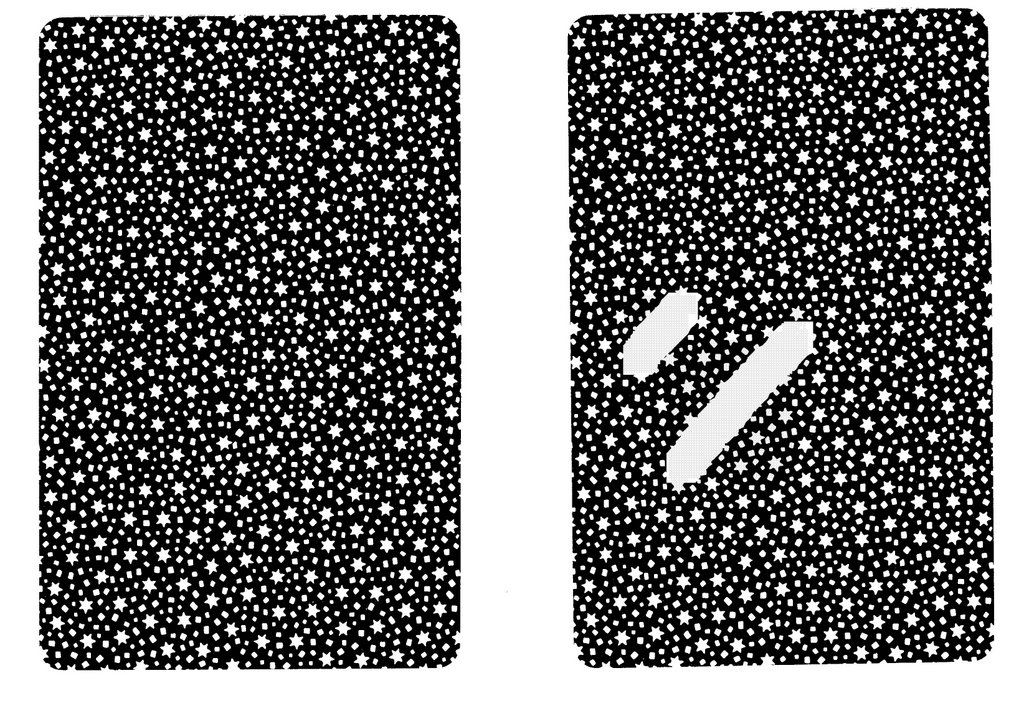
What I’d discovered, quite by accident, is that the Haines’ pack of ESP cards is marked. I’m not referring to the tiny markings at the corners, those are quite well known, but two big broad strokes on the backs that can be read across a room. In fact, here’s the peculiar thing. They can only be read across the room. Go up to the pack, examine the backs of the cards and I promise you you’ll never find those markings unless you know where to look.

Some years later, I mentioned this to magician and mentalist Ray Hyman on the phone, saying only that the Haines cards were marked. It’s a one-way mark, which is how I knew where the Star was on that table. I’d noted that its back was the wrong way up compared to the others. Anyway, Ray was coming to England to appear in a television documentary, and I met him at the airport on his arrival. First thing he did was bring out a deck of Haines ESP cards and ask where the hell the marks where. He’d been examining them on his plane journey and just couldn’t find them. But that’s the beauty of it. Look at the cards up close and it’s impossible to spot them. Put the cards on a table across the room, and they are as clear as day.

Enough of the teasing. The marks are the result of a flaw in the spacing of the tiny stars on the back of the cards. It produces two broad strokes across one end. And you can only see the strokes at a distance. I’ve tried to illustrate the position of the strokes in the diagram (1). Both cards have the marks at the same end, but I’ve highlighted them on the second card. They are impossible to see in the first card because of the reproduction process but if you had the real cards in front of you, you would be able to pick them out. Dig out a pack and try it for yourself.

As soon as you get near the cards, the markings disappear from sight, which means you have to be careful when sorting them into a one-way arrangement. Reading the cards up close is an acquired skill. Reading them from a distance is much much easier.

As for applications, well like names of the Devil, they are legion. Set up a pack in the usual Circle, Cross, Lines, Square, Star order. Have every Star arranged the wrong way and you have a stacked deck you can read across the room. Someone can cut and cut and deal four cards onto the table. You immediately know their order (if no Star appears, obviously you have the other four cards). From here, miracles can be worked.

The best kind of effect is one in which you stand well away from the spectator and the cards. A hands-off routine, possibly working with two spectators sitting at different tables, as they would be if involved in an old Duke University telepathy test. It’s a scenario that gives you a good excuse to use the cards. Have the spectators sit back to back, so that they can’t see each other. You, of course, can see all the cards as they are cut and dealt and you’ll find it easy to bring about remarkable coincidences just by controlling their actions and introducing one or two instances of Magicians Choice. I’ll leave the rest to you.

NOTES: This item was originally contributed to Trevor McCrombie’s online magazine The Centre Tear. As several readers proved, the marking system can be used in a variety of ways. So have fun!

Friday, July 07, 2006

A TRICK FROM ERIC MASON


Twenty years ago the late Eric Mason devised an effect called Stigma. It was an original idea involving the number and suit of a named card appearing as blisters on the performer’s fingers.

As similar effects are now coming onto the market I thought you might be interested in Eric’s original, taken from the notes and illustrations he gave me on 1st August 1986. They are only notes, not a full step by step description, but they should be enough to get a good idea of how Eric approached the problem. What a farsighted genius he was.

STIGMA by Eric Mason
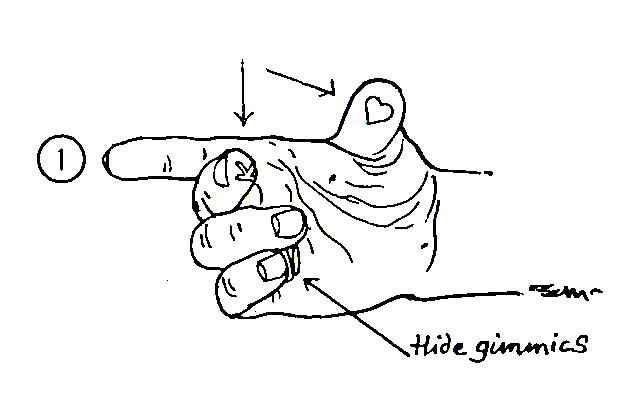
To impress with any card called for! Ask the spectator to think of a card and visualise it as a large image and then to mentally compress it down to say approximately a half inch size. Reaching forward to confirm you pluck the image from its moment of time and space – your fingers appear to BURN! Gosh! You say – as your fingers open to show two blisters which represent the thought card, ‘I would have been burnt for this 300 years ago!’ (1).

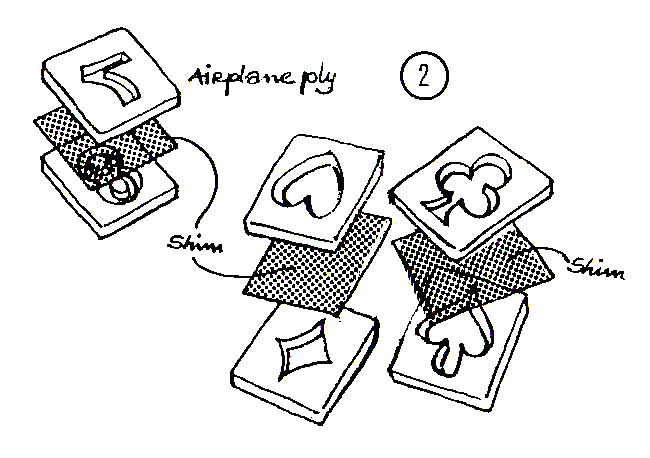
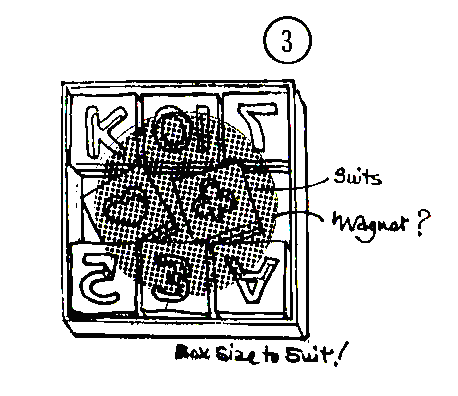
Make up some gimmicks in airplane ply by cutting or burning out the indices of cards (2). Stick them together in pairs and assemble them as an index with perhaps a magnet added as (3). Placing (say) pairs together so that only two gimmicks have to be stolen out of an eight section index to render any playing card.

You do this by placing two tabs together and squeezing between the second finger and thumb. Raise a fake blister on both fingers allowing the tabs to drop into a finger palm where they remained concealed (1).


Monday, June 05, 2006

OPEN AND SHUT CASE

This item was previously published in New Talon number 3. It was inspired by Jack Yates’ effect Clue from his book Clue and other Miracles. It can be presented as a murder mystery game. But my main reason for describing it here is to highlight the method, which might interest anyone familiar with those logic puzzles featuring liars and truth-tellers.

Effect: The performer invites six spectators play the part of suspects in a game of murder. One of them is a murderer but only the murderer knows that. Three of them are compulsive liars. Fortunately the other three always tell the truth. The task of the performer is to navigate his way through this maze of deceit and correctly identify the murderer. Naturally, he always does.

Method: I’ll just describe the bare bones of the method. If you like the idea, you’ll find ways of dressing it up and devising an entertaining presentation. To perform the trick you’ll need six blank cards. On three of them write the word LIAR. On the other three write the word TRUTH. You’ll also need a bag (cloth or paper), five white counters and one black counter.

Arrange the cards so that they alternate TRUTH, LIAR, TRUTH, LIAR, TRUTH, LIAR. Put the counters in the bag. Get yourself six volunteers and you are all ready to go.

Bring out the cards. Display a couple of them to show that some of them bear the word LIAR while others contain the word TRUTH. Don’t mention anything about there being an even distribution of LIAR and TRUTH. And don’t reveal the fact that the words alternate. You may indulge in a brief false shuffle but if you do make it a casual looking one.

Arrange your six volunteers in a line. Get the attention of the first volunteer and show him how to cut the cards and complete the cut. Make sure he understands the procedure and then hand him the cards face down. Tell him to put the cards behind his back and give the cards a cut. And then another one. As he does this take out the cloth bag.

When he’s finished cutting the cards, ask him to take the top card of the packet and pass the remainder of the cards to the next volunteer. The second volunteer takes the new top card of the packet before passing the packet on to the third volunteer. Each volunteer takes a card from the top and then passes the cards on until all six volunteers have a card each.

Tell the volunteers to take a peek at the card they are holding. The cards tell them which roles they should play. They will either be a truth teller or a liar. You must really hammer it home that if the volunteer is to play the part of a liar he must lie all the time. It doesn’t matter what he says as long as it is a lie. On the other hand good liars tell lies that can be believed. The opposite applies to the truth-tellers. You cannot overemphasise this. So make it part of your presentation, talking about the compulsive liars and truth-tellers that are part of this story.

Look away while the volunteers peek at their cards. They can put the cards away when they’ve noted their role in the game. Explain that each volunteer will be asked to reach into the bag and pull out one of the counters. Whoever draws the black counter will play the part of the murderer.

The bag is passed from one volunteer to another so that they can draw counters. They hold the counters in their closed fists. Then, when everyone has one, you turn away and the volunteers look at the counters noting whether or not they have the black one. No one allows anyone else to see which counter they have. Only the person with the black counter knows that he or she will play the role of the murderer in this game. The counters are placed out of sight with the cards.

Let’s review the situation. You can’t possibly know who the liars are and who the truth-tellers are. And there is no way for you to know who chose the black counter so you don’t know who the murderer is either. And yet that is precisely what you are going to reveal. And you can do it with one simple question to each volunteer.

Example 1: Let’s assume that the third volunteer in the line of six is the murderer. Let’s also assume that because of the prearrangement of the cards the line alternates TLTLTL, which makes the third volunteer a truth-teller. If you ask each volunteer, “Do you know who the murderer is?” you would get the following yes or no answers: No, Yes, Yes, Yes, No, Yes.

You can see a pattern emerge. There is a block of three ‘yes’ answers. The middle volunteer of any block of three similar answers (in this case it happens to be ‘yes’) will be the murderer. It always works. If the alternation of the cards had made the third person in the line a liar, then you would have a block of three ‘no’ answers and the middle volunteer of this block would be the murderer.

You can also deduce that if the block of three answers is ‘yes’ then the murderer is a truth-teller. If ‘no,’ then the murder is a liar.

Example 2: The block of three might be split by the end of the line but if you are familiar with any kind of stack you will still be able to pick out the block of three. For instance, if the first volunteer in the row is the murderer and the row alternates LTLTLT then the answers to your question will be No, No, Yes, No, Yes, No. The block of three is split but it should be clear that the first volunteer is the middle one of the split block.

By asking only one question of each spectator you can instantly identify the murderer. When presenting the effect it’s best not to ask the key question, ‘Do you know who the murderer is?’ immediately. Instead, give the volunteers time to get into their roles of liars and truth-tellers. If you are presenting this as a murder mystery party you might ask them to think about what they had for dinner. Or to drink. And warn them that in a moment you will ask them a question and that the truth-tellers will always tell the truth but the liars will always lie. Then make good on your promise by asking what each of them what they had for dinner. Make light of the various answers you receive.

You now ask each of them the key question. But do it at random. Don’t just go along the line. Remember who gave what answer. Spot the block of three and deduce who the murderer is and whether they told the truth or a lie. In the finale you first reveal whether the murderer is a liar (a double sin) or a truth-teller. And then go on to identify him or her. It’s as simple as that but as with everything it will only be as entertaining as your presentation. So dress the routine as best you can.

Notes: Although you are looking for a block of three similar answers you can, in some circumstances, identify the murderer from questioning as few as three volunteers. Take Example 2. You only need answers from the first three volunteers (No, No, Yes) to tell you that the first volunteer is the murderer. That’s because if you hit two similar answers you are already in the block of three. Now you can ask the rest of the group completely different questions. It’ll confuse any clever puzzle-savvy folk trying to work out the method.

Need I mention that once you understand the basic principle you can improvise using a deck of playing cards and other items rather than having specially made cards, counters and bag? It makes a good impromptu party trick. Provided everyone is sober!

Friday, March 17, 2006

SYMPATHETIC CARDS FROM POCKET
Jesse Demaline had some very clever effects in The Magic Wand magazine but his Sympathetic Cards from Pocket (issue 254) may have been overlooked because of a typo in the article. It’s an intriguing effect. A diabolically simple method. And holds lots of potential for individual variation. Read on.

Effect: Imagine having three cards selected from a blue-backed deck. They are free selections and you really have no idea what cards are being chosen. Meanwhile, a second spectator is shuffling a red-backed deck of cards. They hand it to you and you place it in your jacket pocket.

Now for the magic; you reach inside a remove a card from the shuffled red-backed deck. Amazingly, it matches the first selection. You repeat the feat, pulling out another card and revealing that this one matches the second selection. Finally, you pull out a third card. And yes, it matches the third selection.

Method: It's a great effect and not difficult to do but I bet the method will disappoint you. That would be a pity, because it really is such a good routine. Here goes:

It all depends on using a Mene Tekel Deck. I can hear half of you crying "No!" and the other half wondering what the devil a Mene Tekel Deck is. To be honest it's not much used these days. It is a gimmicked deck consisting of twenty-six different cards and their duplicates. The cards are arranged in pairs and the rear card of each pair has been trimmed a little shorter than its mate. It's similar in construction to the more popular Svengali deck. You'll find more about the Mene Tekel Deck in Hugard's Encyclopedia of Card Tricks, if you're interested.

For this effect let's assume that the Mene Tekel Deck is blue-backed. The red-backed deck is quite ordinary and unprepared and is handed out to a spectator for shuffling. As that is done you bring out the Mene Tekel Deck and give it a few cuts. You can riffle spread the deck face up on the table if you want to show all the cards ordinary, or riffle through them as you would with a Svengali deck. After that you let the cards dribble from the right hand to the left and ask a spectator to call "stop." Stop the dribble action and thumb off the top card of the left portion of the deck and ask him to take it. That will be his selected card.

Because of the construction of the deck, it leaves a duplicate of his card on top of the left portion. Replace this packet on top of the right hand packet, bringing the duplicate to the top of the deck.

Now you go to a second spectator and have another card selected. Again dribble the cards from the right hand and into the left. Ask him to call "stop" at any point and offer him the card stopped at as before. This time you can't cut the deck to bring to the duplicate to the top. Instead, as you bring the right hand packet to the left, you simply thumb over the top card of the left packet and slide the right hand packet below it.

You don't need to make a move out of this. Just do it. If you want to cover it a little, turn to your right as you walk towards the next spectator and at that point ask him to look at his chosen card. As he does, make the move.

Dribble the cards again and ask a third spectator to call "stop." He does and is offered the top card of the left packet. Again, you bring the packets together and slide the new top card of the left portion onto the right portion as it is apparently replaced. If you've done all this correctly, you will have duplicates of each selected card on top of the deck. We're almost there.

Get a break under the top three cards of the deck and palm them into the right hand as you ask the spectator with the red-backed deck to stop shuffling. With the right hand, put the blue-backed deck down on the table. With the left hand, take back the red-backed deck. Transfer it to the right hand and place it into your right jacket pocket. Before the right hand comes out of the pocket, it leaves the palmed cards on top of the deck. The finishing line is in sight.

The rest is just showmanship. To produce the first spectator's card you pretend to fiddle around in your pocket and then bring out the third card down from the top. It's actually got a blue-back, not a red-back, so be careful not to expose it as you show the card and drop it face up onto the table. It matches the first spectator's selection. Similarly the second spectator's selection will be found second card down from the top. And the third spectator's selection will be the top card. Just be careful not to expose the backs as they are produced.

There's not really much more to it. By choreographing the effect properly you will make it easier for yourself. The three spectators who choose cards should be in front of you from left to right. Moving between them will help cover the repositioning of the duplicate cards. The spectator who shuffles the red-backed deck should be on your left. Moving towards him will help cover the palming of the duplicates. It also means it is natural to reach out to him with your left hand and take the deck back.

Final Notes: You can play around with different moves to get the duplicates to the top of the deck but I don't think it is worth complicating it too much. A simple modification you could make is in the loading of the duplicate to the top of the deck. Instead of just pushing the card over the side of the deck, to the right, pull it back with the thumb so that it projects an inch or so at the inner end of the deck. The right hand, now lying by your side, comes up towards the left portion of the deck, hits the injogged card and slides right under it as it is replaced on top of the left portion. It works smoothly and is well covered from the front if the left hand is held high and the deck tipped slightly towards you.

I did experiment with a Mene Tekel Deck arranged so that instead of alternating short/long the pairs alternated long/short. This meant that after a spectator had taken his selection, the duplicate was actually on the face of the upper (right) half of the deck. As the halves were brought together it could be loaded beneath the deck via the Ovette/Kelly move or one of the many variations such as that of Bruce Elliott's in 100 New Magic Tricks. Instead of the duplicates being top-palmed and loaded into the right jacket pocket, they are bottom palmed and deposited in the left. I'm not sure it was any improvement though.

Finally, you can dispense with the palming altogether if you just dip your right hand (and deck) into your right pocket as if opening it ready to receive the red-backed deck. Leave the duplicate cards behind. Put the blue-backed deck away and take the red-backed deck at fingertips and drop it into the pocket alongside the duplicates. The rest is as written.

Monday, March 13, 2006

So Special
Effect: This is an ambitious card routine using five cards. One of the cards repeatedly rises to the top of the packet. Finally it demonstrates its prowess by penetrating up through the entire deck.

Method: Packet Elevator tricks are not new but this has the distinction of using the double deal as the crux of the method. I was prompted to dig this out of the notebooks after reading Peter Duffie's book Card Conspiracy, where you'll find a number of routines using this sleight. The basic handling is also described in Hugard and Braue's Expert Card Technique, though with a full deck rather than a packet.

Begin by having five cards selected from the deck. Upjog each card as it is pointed to and then strip the five selections out.

Put the deck aside, but within easy reach, and spread the five selected cards between the hands and ask the spectator to choose just one of them.

Give him a pen to sign his name across his selection.

As he signs the card, make a Half Pass of the lower three cards of the four card packet that you are still holding.

Take the pen back and put it away. Then take the signed card and place it face up on what appears to be a face down packet of cards in the hands. You are holding the cards in the left hand dealing grip which is perfect for the double deal.

"The fact that you chosen this card from all the rest gives it a sense of pride. Really. It thinks it's special. Let me show you what I mean."

You apparently turn the signed card face down but in reality you execute a double deal, turning the top and bottom cards over as one. This puts the signed card second from the top.

Remove the top card with the right hand and with the left hand thumb push over the new top card of the packet. Don't spread the packet or you will expose the reversed cards. Now put the 'signed' card below the top card of the packet and square the cards up.

"Let me try to put your card second from the top."

Snap your fingers, do a dance or whatever else it takes to 'make the magic work' and then turn over the top card of the packet to reveal that the signed card has returned to the top.

"You see, it just won't settle for second spot. Thinks it's special. Got to be number one. Let's try again."

Execute another double deal as you apparently turn the signed card face down on top of the packet. Remove the top card face down in the right hand.

"This time we'll place it third from the top."

The left hand thumbs over the top two cards of the packet, again being careful not to expose the reversed card. Place the 'signed' card under the thumbed over cards, pause so that the spectator can appreciate the situation, and then square the packet. Snap your fingers and flip over the top card to show that the signed card has once again returned to the top.

Incidentally, all the turnovers should look alike. Don't use one handling for the double turnover and another when you are flipping over a single card.

"Okay, here's a toughie. This time it goes fourth from the top."

Execute a double turnover to flip the signed card face down. Remove the top card and this time place it fourth from the top of the packet. There are no more reversed cards so you can spread the cards widely when you do this.

Another click of the fingers and you can turn the top card over to show it is the signed card.

"Now this is difficult. Five cards, never been done. Watch."

Genuinely turnover the top card and then place it to the bottom of the packet. You spread the packet to show that it is really being placed there.

To get the card back to the top you execute a double turnover as you apparently flip the top card over. This leaves a face up card hidden under the face up signed card sets you up for the finish.

"Amazing. Almost don't believe it myself but your card can do even better than that. Look."

Execute a double turnover of the top two cards of the packet. Deal the top card, apparently the signed card, face down onto the table. Drop the rest of the packet face down on top of the face down deck which you put aside earlier. Pick the deck up and dribble it face down onto the table 'signed' card.

Ask the spectator to tap the top card of the deck and turn it over himself. He should be surprised to find that it is his signed selection.

And that's it!

Sunday, March 12, 2006

Straight to the Point
I think it was Bob Ostin who first showed me how effective this trick could be. You've probably even read it. It is described under the title Round and Round and can be found in Chapter Five of The Royal Road to Card Magic, but it seems to have been overlooked by almost everyone.

The original made use of the Glimpse but that is not used in this version. The mechanics of the trick are almost childish but the timing and presentation turn what is really a very obvious ruse into a real baffler.

Begin by having a deck of cards shuffled and then five cards dealt face down onto the table. Ask a spectator to pick them up and mix them. Tell him to make sure that no one sees any of the cards. When he has finished shuffling, ask him to look at the top card of the packet, remember it, and replace it. You can turn aside while he does this. You want to make the most of the impossible conditions under which this location trick takes place.

"Okay, now put the cards behind your back. You're thinking of a card and I now want you to think of a number too. A simple number from 1 to 5. It's a free choice: 1,2,3,4,5. Chose any one of them and think of it. Got that?"

"I'm going to turn away while you do the next bit because I don't want you to think you're giving me any clues as to what is going on. You're thinking of a card. And you're thinking of a number. Now, whatever that number is, I want you to move that many cards from the top of the packet to the bottom. Do you understand?"

Repeat the instruction if he doesn't.

"Do it silently and slowly so that no one here could possibly know whether you're moving five cards or just one. Let me know when you've finished."

The spectator moves his cards and tells you when he has done.

"Okay, I'm still not looking at you. Will you place the cards face down into my hand."

You extend your hand behind you and take the packet of cards. As soon as you have them, turn to face him, keeping the cards behind your back.

"What I'm going to try and do is imagine I'm you. I'm going to try and imagine I'm thinking of a number and thinking of a card. The same card that you're thinking of."

Look him in the eyes and pretend to concentrate. Really you reverse the order of the cards behind your back and then move two cards from the top of the packet to the bottom. It doesn't matter if anyone sees you moving cards around. You're trying to imagine that you are him so it's reasonable that you will be duplicating his actions.

Suddenly, pretend that something is wrong. Something is not quite right. Turn away from him and hand him the packet of cards behind your back. You've still not looked at any of the cards.

"No, sorry, it's just not happening. Take the cards again. Put them behind you're back. Really think of your card……… Okay. That's it. Now think of your number again. And move that many cards from the top of the packet to the bottom. Do it slowly, do it quietly, don't let anyone know how many cards you're moving. Let me know when you've finished."

He tells you he has finished. You turn around but don't quite face him. Instead you extend your right hand and hold it palm up in front of him.

"Good, now take the top card bring it out and hold it face down above my hand. Keep the other cards behind your back."

He brings the top card out and holds it above your hand.

"Don't let me touch the card."

You don't look at the card either while he is doing this. But you do appear to concentrate and finally, say, "No. Throw it on the table. That's not it."

Ask him to take the next card from the top of the packet and hold it face down above your hand. Concentrate again and finish by saying, "No, that's not it either. Throw it on the table."

He takes a third card from the top of the packet and holds it above your hand. If he's followed the procedure correctly, the third card will be his selection. Trust me, it works. It'll always be the third card down in the packet. Finish by saying, "That's it. That's the one. Would you call out the name of the card you are thinking of?"

He does and you turn to face him. "Turn over the card." He'll be amazed to find that it is indeed the one he has been thinking of.

If you want to short cut the trick even further, ask him to think of the number first and then look at the five cards. He then remembers the card lying at his number from the face of the packet. This way he only moves cards from the top to the bottom of the packet once during the routine. It's a strong trick. You never looked at the cards, you never asked him for his thought of number, and you never touched the cards after he took them back. It's almost a miracle!

Final Notes: Want to tell him his thought of number too? All you need do is nail nick or crimp the top card of the packet before you hand it back. When you come to the revelation, have the third card, his selection, placed aside. Make it clear that's the card you are getting psychic vibes from. But just to make sure have the fourth and fifth cards brought out too, one at a time. You don't get any vibes from them so they go onto the table with the others. I should mention that the discards are dealt into a pile.

Now ask him to name his thought of card. He does and you have him turn that third card, the one placed aside, face up. It is his. He thinks the trick is over. That's your chance to glance down at the cards on the table. When you spot the crimped/nicked card, you can work out the thought of number because it will be that number of cards from the top of the packet. Don't forget to factor the third card into your calculations. Have the spectator concentrate on his number and reveal it in your best Dunninger manner.

Wednesday, April 13, 2005

Cyclic Aces

This idea was first published in Sorcerer magazine, issue 2 (1988). It’s a simple idea but you might find it useful. It’s also a good excuse for me to try out the OCR software on my new scanner. Let’s hope it works and following is transcribed without too many errors!

Effect: A deck of cards is shuffled, squared and placed in the centre of the table. “It is said that three is a lucky number,” says the performer, “Let’s see if that’s true.” The performer cuts the deck into three packets, stacking one on top of the other and bringing a new card to the top of the deck.

He turns the top card over and it is an Ace. Placing the Ace aside he says, “Well that’s pretty lucky, an Ace.” The performer cuts the cards again, saying, “Of course that’s all it was, pure luck. The odds against doing the same thing again must be pretty phenomenal.” After the cutting the new top card of the deck is turned over and is seen to be another Ace and this is placed with the previously tabled Ace.

The deck is cut again as the performer says, “Three cuts each time, and this is the third time... third time lucky perhaps.” The new top card is turned over and seen to be the third Ace. It’s placed aside, with the first two Aces, and the cutting procedure is repeated.

I should add at this point that the cutting procedure looks incredibly fair, to layman or magician, but despite this, when the new top card is turned over, it is the fourth Ace.

Method: This is more than just an Ace Cutting Routine, it’s a utility principle that you can expand upon and use in many different ways. The whole procedure is made possible by using one crimped card but it’s the novel way in which the crimped card resets itself for each Ace that is of interest. You’ll be glad to know that the trick is entirely self-working.

Place two Aces on top of the deck and the other two, together, about one-third from the face of the deck. crimp the card that lies above the lower pair of Aces. The crimp should be bent downwards and be positioned at the inner right corner of the deck when the deck is tabled face down.

False Shuffle the deck, retaining the positions of the Aces and crimp. An easy way to do this is to cut off the top third of the deck and Riffle Shuffle it into the upper third of the remaining portion. You are Riffle Shuffling above the Crimp and you allow the top two Aces to fall last. This can be repeated several times. You’ll find it even easier if you position the crimp and the Aces below it lower down in the deck before you begin. It will make no difference to the subsequent working.

Spread the deck face down just to show that there are no breaks or whatever and then square it and place it in the centre of the table. You place the deck almost at arm’s length from you. This is for two reasons. Firstly it is a very open gesture; somehow if the deck is away from your body it seems as if there is little you can do in the way of trickery. Secondly it enables you to see your crimp perfectly, a visual check just in case you foul up somewhere along the line.

Reach over and cut approximately one-third of the cards from the top of the deck and place them on the table, beside the original talon. Make a second cut, this time at your crimp, the crimped card becoming the face card of the packet you have just cut. Drop this packet onto the first tabled packet. Pick up the remainder of the deck and drop it on top of the first two portions. Turn over the top card, it will be an Ace.

The cutting can be made to look quite sloppy and effortless, which it almost is, thus adding to the deception. The remarkable thing is that the crimp is again nearly two-thirds down the deck but is now above what were the top two Aces.

Square the deck and repeat the cutting procedure, bringing another Ace to the top and setting the crimp above the third Ace. As each Ace is cut it is laid aside. Cut the deck again, bringing the third Ace to the top and at the same time setting the crimp above the last Ace. Finally cut for the fourth time, bringing the final Ace to the top and revealing it in your most dramatic manner.

Notes: That’s all there is to it but I hope you’ll agree that it is very deceptive and it seems almost impossible to control the Aces during the cuts. The fact that it is self-working should make it easy to use.

Those with a penchant for card handling can of course cull the required Aces to position. You might also like to just locate any pair of cards that happen to be together, position them about one-third in from the face and crimp the card above them as you spread the cards face up in front of you. This leaves only two cards, the other pair, which need to be cut or culled to the top, making your job that little bit easier.

To crimp the card I spread the cards face up between my hands, from left to right, raising them to a vertical position so that only I can see the faces. Having spotted a suitable pair of cards I spread them to the right and use my left thumb to crimp the lower left corner of the card immediately behind them. The left thumb just bends the corner upwards, towards the card’s face.

Vernon’s Aces Ride Again: By reversing the procedure you can use the crimp card to control the aces. In this version you openly places the aces into the deck, apparently at random, and then find them again. Pointless I know but that’s the magic business for you!

Start with the four Aces face up on the table and a crimp card two-thirds of the way down the deck. Cut off about one-third of the deck and table it. Take one of the Aces and drop it onto this packet. Make another cut, this time at the crimp, and drop this packet on top of the just-placed Ace. Pick up the remainder of the deck and drop it on top of the first two cut portions. You’ve secretly placed the crimp above the first Ace while apparently losing the Ace in the deck.

Repeat the procedure, cutting off about a third of the deck and tabling it. Place a second Ace on this portion and then cut another packet from the deck, again making the cut at your crimp, and drop it on top of the Ace. Pick up the remainder of the deck and drop it on top of the first two cut portions.

Repeat this for the third and fourth Aces and you will end up with two Aces on top of the deck and two below the crimped card. By reversing the original procedure you have arrived at the start position for the original Ace Cutting. Reveal the aces in any way you choose.

Not Quite Final Notes: There is more to say on this system but it will only detract from what is offered here. However, when setting up the Aces for cutting (the first routine) you may like to introduce the same sort of ruse that Vernon used in his Cutting the Aces routine (Stars of Magic). You can do this by setting the deck with an Ace on top, followed by a Six-spot, then five indifferent cards, the second Ace, then the rest of the deck with the crimp card set two-thirds of the way down just above the remaining pair of Aces.

Proceed with the first routine, cutting the first, second and third Aces as already explained. When you try to cut the fourth Ace you turn over a Six-spot instead. It looks as if you’ve missed but you recover the situation by explaining that the six in fact tells you that the last Ace is six cards down. Place the Six­-spot aside and then deal down six cards from the top of the deck, turning the Ace up on the last card dealt. The extra twist on the fourth Ace brings the routine to a more satisfying conclusion.

If your table space is limited you can always hold the deck in the left hand dealing grip and place the cut off packets on another spectator’s outstretched palm. Ask him to pretend he’s a table and then tap him on the head, knocking on wood for good luck.

A Four Star Discovery: With the deck in the left hand dealing grip and a crimp card a third in from the face, riffle down the outer left corner with the thumb and ask a spectator to call stop. Contrive it so that he halts you when you are about one-third down from the top. Cut this top packet to the table. Push off the new top card of the deck and raise it towards the spectator so that he can remember it. This will be his selection. Drop the selection face down on the tabled packet. Cut at your crimp and drop this packet on top of the selection. Place the remainder of the left hand cards on top of all, burying the selection completely.

Repeat this with three more selections and you will finish up with two selections on top of the deck and two under the crimp. It seems impossible since you do virtually nothing. The cards are in position to be revealed just as in the original Ace Cutting Routine.
However, to add spice to the proceedings try the following:

Hold the deck in the right hand, in position for an Overhand Shuffle with the cards facing left so that you can see them. Note the face card. Let’s imagine it’s a Six-spot. Pull the top and bottom cards off together, into the left hand, mentally counting ‘one’ and then draw off five more cards from the face of the deck, counting each one and bringing your count to ‘six’ which is equal to the noted card. The drawn off cards are shuffled on top of the original milked pair.

Drop the remainder of the deck on top and continue with any False Shuffle or Cut which retains the deck order. You can now cut to three of the selections, just as in the original routine. On cutting the fourth selection you will turn up the Six-spot. It looks like a mistake but you rectify it by dealing six cards off the deck and turning up the final card to reveal the fourth selection. Incidentally the selections will turn up in the reverse order to which they were chosen. That’s all for now. Have fun.