
NOT THE BERGLAS EFFECT
This is the follow up to The Bogus Effect described previously on this blog.
It is too long to post here but I've now sent a pdf out to everyone who requested it. This offer is now officially closed.
The mss includes some other thoughts and trivia on card at any number effects. Hope you get something out of it, if only inspiration.
If you haven't received yours it might be because it got stuck in your spam filter. Or got bounced because you have one of those systems set up that requires email verification. In which case email me again and I'll send you another copy.
And remember, this is definitely NOT The Berglas Effect.
Friday, February 29, 2008
IMPOSSIBLE CARD LOCATION
Expert Card Technique contains an ingenious effect of Paul Rosini’s called A Rosi-Crucian Mystery. It is a card location trick done under seemingly impossible conditions. When Fred Braue ran a Best Five Tricks poll in Hugard’s Magic Monthly, the Rosi-Crucian Mystery topped the list of card discoveries. It is a very clever trick and would fool magicians today if for no other reason than it uses a technique that has long fallen out of use. Check it out.
EFFECT: Magician borrows a deck and cuts it into two face-down piles. The spectator shuffles each pile before choosing one of them. He takes out any card, remembers it and then places it in the other pile. This is pile is now shuffled and placed on top of the other pile, which is also shuffled. The deck is cut several times. The performer finds the chosen card.
Bear in mind the conditions under which the trick is performed. The deck is borrowed. It is shuffled by the spectator before the trick begins. The selected card is a free choice. Both piles are shuffled by the spectator before the deck is handed back to the performer.
Really think about it before reading the solution.
METHOD: Dunninger’s solution was unique. He’d simply fail to find the card. At least he would fail the first time he tried the trick. But on the second attempt he always succeeded. And it was the second attempt that magicians remembered. Here’s the handling.
Have the deck shuffled, take it and then cut it into two equal piles. Let the spectator choose a pile, then a card, remember it and place it in the other pile. The spectator shuffles both piles before stacking one on top of the other and cutting the deck several times before handing it back to you. You now give the cards a false shuffle for added effect.
There is, of course, no way you can locate the spectator’s chosen card. However, you can at least make a guess at it, especially if you've noted the bottom card of the deck before placing it on the table. If you’ve watched the spectator carefully you will have an idea of where the card is located. You watched him put it in the middle of one pile and you know whether that pile is at the top or bottom of the deck. So you look through the deck, cut your key card to the face, and make a guess. You might even hedge your bets by querying the colour before throwing a card onto the table.
Dunninger made a guess too. And didn't bother with the key card business. But as he looked through the deck he did secretly separate the cards into reds and blacks and put a crimp in at the point the two colours met. It’s said that all this took place as he held the cards under the table. Sitting opposite your spectator at a table makes this an easy trick to do. But modern culling techniques allow you to do much the same thing in the open.
So a card is on the table and if you’re lucky you have just found your spectator’s selection. If not, don’t worry about it. Just apologise that the vibes aren’t right or something else went wrong and offer to try the trick again. This time when you cut the deck into two piles, one will be made up of red cards and the other will be made up of black cards. It’s going to be a very easy matter to locate the spectator’s card.
NOTES: The reason magicians were fooled is that they are very happy to accept the explanation that a good trick went wrong the first time around. The trick reminds me of David Bendix’s satirical essay on Further Cardmanship in The Heirophant. He wrote, ‘If an effect fails, it is far, far better to have fellow cardme
I’ll be posting some thoughts on impossible locations in the upcoming weeks. By the way, those waiting for their copies of the Not The Berglas Effect manuscript should see them in their
Monday, February 11, 2008
NOT THE BERGLAS EFFECT IMMINENT
I know the mss is late but I hope it will be worth it when it is sent out. At the eleventh hour I discovered a couple of things that might be of interest and have decided to add a bonus effect that is related.
When the mss is released I will let everyone know via this site. That way anyone's mss who gets chewed up in the spam filter can email me and I'll send out a replacement.
And remember, patience is a virtue.
Wednesday, January 30, 2008

YET ANOTHER ANY CARD AT ANY NUMBER
You are probably wondering what the above has to do with ACAAN. Read on and all will be revealed.
This blog entry began when Steve Williams
It is an amazing trick and if the advert reproduced above has you baffled you might want to dig out your copy of Encyclopedia of Card Tricks. The trick is described in Chapter One under the title of The Card Miracle – Certain. And it really is a miracle.
But back to The Trick That Baffled Babbage, and the following version which as you will gather employs estimation, one question and some blatant jiggery-pokery to achieve a yet another thought of card at any number trick. It seems we can never have too many. Let’s call it…
THE EVEN SIMPLER TRICK THAT BAFFLED BABBAGE
One spectator selects a card. Another selects a number. The selected card ends up at the selected number in a seemingly impossible manner. No gaffes, no fakes, no specially printed cards, no stacks, no stooges, no complicated memory work, no vember. *
HANDLING
I’ll ignore the patter and get straight to the handling but something along the lines of the previous item, The Trick That Baffled Babbage, should give you an excuse for all the dealing.
Step 1: The spectator chooses a card. This is done in the fairest possible manner. Either by him cutting the tabled deck and looking at the card cut to. Or by memorising one from a bunch as the cards are spread in front of him. Either way you are able to estimate the position of the card from the top of the deck. And he is utterly convinced that you have no idea which card he might be thinking of. This was the strength of Abbott’s Certain card trick.
* That ‘no vember’ gag is pure Paul Harris. It should be appended to the end of every dealer ad.
Wednesday, January 23, 2008

ADAMATHICA - AN ACAAN FOR 1921
Often missing from a discussion of Any Card At Any Number is mention of a trick by Bertram Adams called Adamathica. He marketed it in 1921 as a set of instructions in hardbound form. He said he had 100 copies for sale and I would imagine it is quite rare. I found a set of instructions at Ask Alexander.
The effect is described as follows:
Spectator is asked to make a free mental selection of any card in a deck of 52. This selection is made purely mentally without reference to any deck, hence it is not forced in any way. The same spectator, or another if there be more than one, is now asked to name any number from 1 to 48. The spectator is then told that the card that he has mentally selected will be made to assume a position in the pack at the number mentioned. Through the entire experiment the performer does not see the face of the cards as they are handled face down.
Free selection of card. Free selection of number. And yet the mentally selected card ends up at the chosen number. Sounds impossible.
Unfortunately Adamathica is not the Holy Grail ACAAN that many are seeking. It was a version of the 27 Card Trick, a dealing routine using a full deck in which the mentally selected card to could be manoeuvred to a chosen number. In later advertisements, perhaps sensing some resistance to his mathematical creation,
It was a clever idea and if you’re interested in the mathematics of the 27 Card Trick you can find more in Martin Gardner’s invaluable Mathematics, Magic and Mystery where chapter three is given over to what is known rather amusingly as Gergonne’s Pile Problem.
THE TRICK THAT BAFFLED BABBAGE
EFFECT
‘As is well known, Charles Babbage was the scientist who invented the Difference Engine, a form of early computer designed to make calculations quickly. This was back in the 1820s when the idea of calculating machines was pure science fiction. He was inspired by in his work by an exhibition he saw of a mysterious automaton known as Von Kempelen’s Chess Player. It took the form of a mechanical man dressed in Turkish garb and would sit at a table and take on all comers at games of chess. It usually won. But it wasn’t the chess games that interested Babbage. It was a card trick that the automaton performed. Babbage couldn’t figure out how it could possibly work without some form of calculating machine being employed. And that’s the card trick I’m about to show you.’
The method has two main elements. The first is forcing the total value of the four pocketed cards. The second is manoeuvring the selected card into the right position in the deck.
7 - 8 - 6 – 9 – 5 - 10 – 4 – J – 3 – Q – 2 – K – A – K – 2 – Q – 3 – J – 4 – 10 – 5 – 9 - 6 – 8 – 7 – 7 - 8 etc.
You’ll have two aces left over. Place these on the face of the deck.
Step 1: Tell your Charles Babbage story as you spread the deck face-up. The stack won’t be noticed. Then spread the deck face-down across the table and ask the first spectator to remove any four cards together. Except for the two aces on the face of the deck, he has a free choice. Ask him to put the four cards in his pocket for now.
Tuesday, January 22, 2008
Monday, January 07, 2008
NOTES ON THE BOGUS EFFECT
From the feedback I've been getting it appears that quite a few of you are having Reversed Svengali decks made up to try out The Bogus Effect.
The ever curious Shiv Duggal asked why use a Reverse Svengali when a regular Svengali would do. There are several reasons why I think the Reverse Svengali is better. The first is that it allows the deck to be spread face-up and shown to be made up of different cards. There's no need to spread it face-down and flip it over, which is what you'd do with a regular Svengali deck. That's if you can find the appropriate surface on which to make this maneuver. And in any case to me the spread and turnover feels like a flourish and I don't think that slick moves have any part in ACAAN. You want it to look like a mental feat not a card trick.
The second reason is that I prefer that the spectator cut the deck, look at the card and replace the cut portion. It requires less handling on his part than cutting the deck, looking at the top card and then cutting the deck again to lose it. Using a Reverse Svengali makes the selection process look more impossible. The card remains exactly where he found it. And you can even afford to turn away from the spectator as he 'thinks' of his card.
Having persuaded you to get yourself a Reverse Svengali let me show you how its configuration can alter a trick. The trick in question is Max Maven's Sventalism which is described on page 316 of Jim Steinmeyer's The Conjuring Anthology. It's two-person telepathy effect but you could modify it for one person if you wished.
EFFECT
A spectator freely selects three cards from a deck. She gives one to the spectator on her right, another to the spectator on her left and keeps one for herself. All this is done under the fairest conditions and while the magician's assistant is out of the room. The deck is put away. The cards are hidden in the spectators' pockets.
The magician's assistant now enters the room. The magician says nothing and doesn't even need to be there. Nevertheless, under what appear to be impossible conditions, the assistant can correctly reveal the identity of each selected card.
METHOD
This is a slight tweak of Max Maven's clever method but the use of a Reverse Svengali allows three cards to be selected as opposed to the two in Max's routine.
The secret is simple. On the back of each force card in the deck is marked the identities of the indifferent cards that are either side of it. The Ted Lesley marking material is ideal for this.
Begin the routine by giving the deck a false shuffle. This must be a full deck false shuffle. If that is not in your repertoire then just give it some regular cuts. Cutting the deck makes no difference to the arrangement.
With your assistant out of the room you hand the deck to a spectator and ask her to cut it several times. When she has finished ask her to give the top card to the person on her right and the next card to the person on her left. She takes the third card for herself and you take the deck from her and drop it straight in your pocket without even attempting to glance at it. Ask everyone to look at their cards and then either hide them behind their body or hide them in a pocket. At this point you can leave the room out of one door and your assistant can come in from the other, if that is possible. The idea being that you never meet.
The assistant goes along the row of spectators and pretends to pick up the vibes. The man that was to the left of the assisting spectator has the force card in his pocket. Your assistant psychically divines it and then asks the spectator to produce the card. On taking it back from him your assistant can now read the marks on the back and divine the names of the cards the other two spectators are holding. And that's pretty much that. You come back into room when you hear the applause. Alternatively leave your assistant to face the music if she's screwed up.
NOTES
If all the indifferent short cards in your Reverse Svengali are arranged in a stack, for instance Eight Kings, then you only need mark the identity of one card on the back of the force cards. You can figure out the identity of the third card from the stack.
Thursday, January 03, 2008
NOT THE BERGLAS EFFECT
Following on from The Bogus Effect here is another version of Any Card At Any Number. The dealer advert would run something like this:
THE EFFECT
A spectator thinks of a card. A second spectator thinks of a number. A deck of cards is placed on the table. The performer need not touch the deck from this point on. Only now is the thought of number revealed. The number is counted to and only then is the first spectator asked to disclose the name of his thought of card. You can guess what happens next….
No sleights. No switches. You do not need to touch the deck after the number is called or the card is named. The spectator does the dealing.
Only one deck used. No short cards. No specially printed cards. It will not be the same card or number every performance. Cards before and after the chosen card can be show to be different. Easy to reset. No stooges. Completely free!
METHOD
The method while simple will take some time to explain. And that explanation is far too long to post here unfortunately. However, I'm now completing what I hope is the last draft of the manuscript describing the trick in some detail. If you would like a copy all you have to do is drop me an email and at the end of January I'll be sending out the pdf. See my Profile on this blog for the email address. And yes the manuscript really is completely free.
IMPORTANT NOTE RE NOT THE BERGLAS EFFECT
The offer of the free pdf has been closed since January 08. A lot of people have suggested it should be marketed. A revised and expanded edition is being prepared and will be announced when ready on this blog.
Monday, December 17, 2007
THE BOGUS EFFECT
There are many versions of The Berglas Effect on the market, also known by the acronym ACAAN (Any Card At Any Number), all claiming to be miracles. But the hype for each new release is quickly followed by disappointment as buyers learn that the cleverest part of the trick was the advertising.
Which is why I prefer to call this family of tricks The Bogus Effect. Let’s imagine the advert for this particular version:
EFFECT
A spectator merely thinks of a card. He tells no one. He does not write it down.
Another spectator thinks of any number from 1 to 52. No force. Again nothing is written down. The deck is shuffled and placed on the table. The performer never touches the deck from this moment. For the very first time the number is revealed. The chosen number is counted down to. Only then is the thought of card named. And yes it is the very card at the thought of number. Totally self-working. Resets instantly. The thought of card is always at the called number. The rest of the cards can be freely shown. The spectator deals the cards. The performer doesn’t need to know the number until it is reached. Fifty bucks!
METHOD
You’ve had the hype. Now for the disappointment. That’s because the trick depends on the use of a Svengali Deck. However, there are one or two things about the routine that not only make it effective but should throw off those who already know the Svengali. The first is that you actually use a Reverse Svengali. This is a deck in which all the force cards are long and the indifferent cards are short. I bought mine, in Bicycle Poker Size, from the
If you’ve handled a Svengali deck before you’ll know that you can shuffle it, riffle it and spread it to demonstrate that it’s made up of different cards. Best of all because this is a Reverse Svengali you can riffle spread the deck face-up across the table to show all the cards are different. In short, there’s no reason for the spectators to imagine that this is anything but an ordinary deck. With that in mind, let’s assume that the spectators are convinced you are using a regular deck and get down to the handling.
Step 1: With the deck face-down in the left hand cut it so that an indifferent card is on the face. To do this as the right hand comes over the deck to make the cut, the right thumb presses down on the inner short end to break the deck open. Make the cut at the break. You should now have an indifferent card on the face of the deck.
Step 2: Tell one of the spectators that you want him to think of a card. Demonstrate how you want him to think of a card as follows. Cut the deck, again secretly pressing down on the inner short end with the right thumb. Lift the upper half of the deck towards you and look at the face card as you say, “I just want you to cut the deck and take a look at the card you’ve cut to. Remember it. That’s important.”
Replace the cut portion letting the spectators get a glimpse of the card you cut to. Now demonstrate the cut again. And again you secretly use the right thumb to open up the inner end of the deck so that you cut to another indifferent card. Show the card you have cut to, saying, “But don’t show to anyone else the card. You will be the only person that knows the name of the card you are thinking of. Got that?”
Replace the cut portion of the deck, square the cards, and hand the deck to the spectator. You could, if you feel it necessary, throw in another shuffle and cut here to apparently mix the cards.
Step 3: They’ve just seen you cut to two completely different cards. And now the spectator cuts the cards for himself. Supervise him so that he makes the cut in the proper manner, thumb at the inner end and fingers at the outer end. If he makes the cut normally (and not the way you did) he will be looking at a force card on the face of the upper packet. Keep an eye on him when he does this but at the same time try to appear indifferent to the process as you turn to a second spectator and ask him to think of a number between 1 and 52.
Then turn back to the first spectator and make sure he replaces the cards he has in hand. Take the deck from him and give it an overhand shuffle of the type that doesn’t alter the short/long distribution of the cards.
Step 4: As you shuffle the cards say, “Now not only does no one know the name of the card you are thinking of. But not even you know where it is.” Finish the shuffle so that there is an indifferent card on the face and place the deck face-down on the table. By the way, the only reason I advise you to keep an indifferent card on the face of the deck is to avoid showing a force card if you accidentally flash the face card.
Step 5: Appear to concentrate a little and then say, “Now I’m not really getting much of a sense of the card." Then turn to the spectator who is thinking of a number and add, "But am I right in saying that you’re thinking of an odd number?” This is a 50/50 shot. Either the spectator will say you are right or he will tell you that you’re wrong. But it sets you up for what you have to do next.
The situation is that the force cards are lying at every odd position in the deck. If he is thinking of an odd number you are all set to go. If not, quickly say, “Doesn’t matter. Keep the number to yourself for the moment because I’m not going to do this you are.”
“I don’t want you to think that what you are about to see has anything to do with the way I shuffled the cards. So will you please give the cards a cut.” You motion to him to make a single cut by lifting up the top half of the deck (fingers and thumb at the short ends), placing it aside and then putting the lower half on top of it. Because he will always cut a short card (indifferent card) to the top of the deck it means he has unwittingly placed all the force cards at an even number. Clever eh?
This strategy of getting the spectator to adjust the deck is one I picked up from David Berglas and is described in The Mind and Magic of David Berglas. I call it The Berglas Cut because it is so very useful in effects of this type.
Step 6: You recap the situation. “No one knows the number you are thinking of. And no one knows the card you have in your mind. Let’s see if we’ve been lucky. What is your number?” Whatever number the second spectator calls out have him deal number of cards from the deck into a face-down pile on the table. As he deals stop him one card short of the chosen number.
You have to be careful that he doesn’t expose the faces of the cards as he deals. If he is standing and too far from the table, I suggest you do it yourself but make it as clean and open as possible.
When you get to the selected number slide that card face-down onto the table. Pick up the next card and throw it face-up onto the table, saying, ‘One more card and we’d have ended up here.’ It will be one of the indifferent cards. Take the previously dealt card from the face-down pile and throw it face-up onto the table too. ‘And one number less would land us here. Is either of them the card you are thinking of? No?’
Pick up the remainder of the deck and dealt cards, square them, turn them face-up and make a face-up Svengali style riffle spread across the table. Only indifferent cards will show.
Step 7: You speak to both of the assisting spectators. “You chose the number, you cut the cards. For the first time will you reveal the name of the card you are thinking of.” The first spectator reveals the name of his card. ‘What are the chances of that card ending up at your number?’ Turn the only face-down card face-up to reveal that it is the thought-of card.
NOTES
Using a Svengali deck to produce a card at any number is not new. But I hope I’ve shown that we shouldn’t overlook some of the oldest tools of the magic trade. The Svengali Deck is one of the most versatile of gaffed decks and you might find it of value to go back and read The Encyclopedia of Card Tricks to get an insight into how effective it can be when handled expertly.
Regardless of the method used The Berglas Effect will only come across as a miracle if you present it as such. It should appear to be a spontaneous happening. If you perform any card at any number as part of your regular routine in which the audience have already seen you juggle and flourish with cards, then while it will certainly be a good trick it is unlikely to feel unique enough to be called a miracle.
One of the reasons that The Berglas Effect has the status of a miracle among magicians is that very few have ever seen it. That’s what miracles are, rare, spur of the moment, one of a kind events that the spectators feel privileged to have seen. Don’t forget that there is a certain kudos in saying, ‘I wish you’d been there.’ People like to have stories to tell. And The Berglas Effect is such a story, an event with cards presented in such a way that those who see it feel compelled to talk about it. If you are seeking miracles, then that’s your goal.
Saturday, November 17, 2007

LUNCH BOX
Andrew Loh emailed me about his marketed effect Cardbox Meltdown. He'd heard that it might be similar to an effect of mine, Lunch Box, published in Equinox back in 1985, and wanted to include a credit in his instructions. Here is the write up from Equinox as sent to Andrew. I think it's still an interesting effect even after all these years.
LUNCH BOX
A large ‘sandwich’ with very few calories!
This is a very easy effect and can be ideal for use at a restaurant table if you have been called upon to do some tricks. If it is an office outing then the table could be quite large and whilst the people near you can all see the tricks perfectly, the people at the other end of the table may have to resort to chatting among themselves, simply because the effects don’t involve them at all. Here is one trick that works best for a large group gathered around a lengthy table.
Have any card selected, noted, returned and then control it to the top of the deck. Execute a double lift and ask the spectators if you have accidentally cut their card to the top. They will answer ‘no’, unless of course you’ve made a mistake. With the deck in the left hand (a card apparently face up on top) pick up the card case and throw it to someone just to check that there is nothing inside, no elephants, trapdoors etc. Flip the double face down on the deck and remove the top card with the right hand. The left hand leaves the deck face up on the table and retrieves the card case from the spectator (who ideally should be seated to your left). Place the face down card in the card case and ask one of the ladies to seal it with a kiss. The case is in the right hand allowing the left to pick up the deck from the table so it can be held face down in dealing grip.
Take a left fourth-finger break under the top card of the deck and take the case back from the lady. You apparently examine the case for lipstick marks making some kind of comic remark e.g. ‘Nice shade of red… it goes with your eyes.’ If you are still unharmed you flip the case cover onto the top of the deck. The right hand picks up both case and the noted card (easy because of the break) from above allowing the left hand to turn palm down and drop approx. half of the deck face up onto the table. The right hand sets the case (and hidden card) on top of the tabled portion of the deck and the left hand drops the remainder of its cards face up on top of all. This sandwiches the case in the middle of the deck. make some remark about creating a ‘cardboard sandwich’ similar to that served in… (name of office canteen, restaurant of ill repute or whatever.).
Square everything up and then call for a clear pathway along the table to whoever is sitting across from you. Once the cutlery, glasses and bottles have been removed you ask that the spectator facing you from across the table holds out his/her hands as they are about to catch something… hopefully nothing nasty. With the spectator prepared you ask the selectee again as to whether they are sure that the ‘Three of Spades’ (or whatever card you apparently placed in the box) was not their card because otherwise this is a lot of trouble to go to just to find one card. Ask for the name of the selection and show doubt that it could in fact be that card.
Finally you place your hand alongside the sandwiched case and after an appropriate countdown you flick the case clear of the deck with your forefinger. See the diagram at the top of this post.
The case should be struck hard enough to carry it across the table into the waiting hands of the spectator opposite you. One card will be face down in the face up deck. Ask again for the name of the selection. Flip over the card and say ‘No, sorry it’s the Three of Spades again.’ This should get a laugh. Pointing out that the Three was in the card case you ask the spectator to open up the box. Inside he will find the selected card.
Another idea on this is to actually have a comic pair of lips drawn on one side of the card case. This will provide you with added comedy when having the case ‘sealed with a kiss’. The routine is not designed for the table-hopper but for the amateur magician who frequently gets asked to show a trick or two on the office outing. Only they can get a table cleared for a trick without annoying all those trying to eat at it.
If you'd like more of the same you can order a copy of Equinox from the publisher Martin Breese. It contains more than a dozen similar effects and, if I do say so myself, I think it's pretty good.Friday, August 10, 2007
FOOL'S MATE
This is a simplified handling of an effect I published in the original Talon magazine. There it was used as a version of the ‘Open Prediction’ but I’ve since found that it’s impressive enough without any of the trappings usually associated with the Paul Curry effect.
A deck of cards is shuffled by a spectator. The performer removes one card and asks the spectator to sign his name on the back. The performer writes a prediction under the spectator’s signature but does not show it as yet. “There is only one prediction,” says the performer, “If I try to change it, you’ll know it’s not the original because your signature won’t be on it. I’d like you to take the prediction, hold it face-up, and stab it somewhere into the middle of the deck. I won’t shuffle the cards. I’ll leave them exactly as you left them.” The spectator inserts the prediction face-up into the face-down deck. The deck is spread and the prediction, and the face-down card next to it, removed. On the back of the prediction the performer has written just three words, “Jack of Spades.” When the other card is turned over it is found to be the Jack of Spades.
The trick is virtually self-working depending on what I like to think is a clever subtlety. You’ll need two identical Jokers in the deck (or you could use a duplicate of any other card) and a quick drying indelible marker pen.
Recap the events that have taken place. The spectator has shuffled the deck and written his name on the back of the Joker. You have written your prediction on the same card. There is no way you can alter your prediction. The spectator’s own signature is a safeguard against that possibility.
Although you have apparently reached the prediction you have in fact only reached the duplicate Joker. Under this Joker is the face-up Jack of Spades, then the prediction Joker also face-up. You are also holding a break beneath these three cards.
Say, “I’ll take the Joker and the card next to it and place them on the table. No one could have known where you would have placed the Joker in the deck.” Immediately execute a Triple Lift turning the three cards as one onto the left hand packet. Deal off the prediction and the next card, face-down onto the table. Ask the spectator to read out what is written on the back of the Joker. Ask someone else to turn over the face-down card. It will be the Jack of Spades. Prediction fulfilled!
NOTES
The duplicate Joker is left on top of the left hand packet. If you decided to use a duplicate of another card instead of a Joker then you can palm it off at this point leaving you with a full deck. If your Jokers are of a one-way design then make sure they both face in the same direction during the handling.
Saturday, December 09, 2006
FOURLOURN
EFFECT
A packet trick using the Ace, Two, Three and Four of Spades. One by one the cards rise to the top of the packet. All except the Four which disappears entirely.
This trick originally appeared in Cardopolis magazine and was inspired by the work contained in Phil Goldstein's excellent booklet Majorminor. Daryl Martinez must also be credited as inspiration with his Twisted Aces routine.
The main point of this handling is to show that by getting rid of the four spot the rest of the routine is virtually self working. Ambitious packet handlings are often quite involved but this one is simplicity itself.
METHOD
Begin with the Ace, Two, Three and Four face up on top of the deck. The cards should be in sequence with the Four uppermost. Spread the four cards to display them as you explain that they will be used for the next trick. Flip them face down on top of the deck but lift off only the top three cards with the right hand. If the right thumb injogs the Four as the cards are flippped face down onto the deck, you'll find it easy to press down on the injogged card and lift off the remaining three.
Place the deck aside and then transfer the packet of cards to the left hand where they are held face down. Flip the top card over showing it to be an Ace. Flip it face down again and Elmsley Count the three cards as four, telling the spectators that you will reverse the order of the four cards therefore placing the Ace on the bottom of the packet. Snap your fingers and turn the top card face up to show that the Ace has returned to the top of the packet.
Turn the Ace face down and apparently place it on the bottom of the packet. Actually you execute a two card push off, take the top two cards as one and place them to the bottom of the packet. With three cards only in your hand a double lift is very easy to do and this is the crux of the whole routine. Snap your right fingers as a magical gesture and execute another double lift to show that the Ace is still on top of the packet.
Turn the double down and take off the top card only placing it under the packet. Snap the right fingers and then turn over the top card to show that once again the Ace has risen to the top. Place the Ace to the bottom of the packet and explain that lest the spectators think all the cards are Aces you will perform exactly the same trick with the Two.
Another double lift is made to show the Two apparently on top of the packet. The double is turned face down and the top card is placed to the bottom of the packet. Snap the fingers and turn over the top card to reveal the Two back on top. Place the Two on the bottom of the packet explaining that what the Ace and Two can do the Three can also perform.
Another double lift is made to show the Three on top of the packet. Turn the double card down placing the top card only to the bottom of the packet as before. Snap the fingers and flip over the top card showing that the Three has returned to the top. Turn the Three face down and leave it on top of the packet.
Take the packet in the right hand and Elmsley Count the cards into the left hand. As the first three cards are counted you patter ‘While the Ace, Two, and Three can do this trick…’ the last card is retained in the right hand flicked with the right fingers and replaced beneath the packet as you continue… ’ the Four is very difficult to handle.’ The Elmsley Count subtly confirms to the spectators that you are using four cards.
You now vanish the Four using the following flourish. With the packet face down in the left hand the thumb pushes two cards to the right.
The right hand takes the two cards away from the left hand. The right thumb pulls the top card of the pair to the right.
In a continuous motion allow the lower card of the pair to fall face up onto the table. Continue moving the right hand to the right and then allow its remaining card to fall face up onto the table. The card trips off the fingers. At the same time allow the left hand card to also fall face up onto the table.
The result is that the Ace, Two and Three are all face up in a line across the table. And the Four of Spades is nowhere to be seen as you say, "... in fact the trick is so difficult that I never do the trick with the Four."
The Four is on top of the deck for subsequent reproduction if you think it necessary. Alternatively you could stage the trick differently and, as in the Martinez routine Twisted Aces you could steal away the Four and reverse it in the middle of the deck in one move. This would provide an effective finish if the Four is to be reproduced.
Naturally some scintillating patter, a dash of charm and a huge dollop of charisma would very much enhance the effect!
Saturday, November 04, 2006
THE SIXTH SENSE
EFFECT: Six spectators are given six slips of paper. One of them writes down the name of a dead person. The other five write down the names of people still living. While the mentalist’s back is turned the people mix themselves up and then one by one step forward and hold their slip of paper to the back of the mentalist’s head. Although he cannot see who is behind him, the mentalist unerringly picks out the dead name.
METHOD: I’m not overly keen on Living and Dead Tests but am using the premise here to describe a very simple principle that enables you to identify a spectator who is standing behind you and out of your range of vision. It has other applications too.
When you select your spectators for this experiment you do so by the watches they are wearing. You are looking for those who wear the more conventional kind of watch. One that ticks!
Everything should now become clear. It is not the sixth sense you are using but one of your usual five, hearing. The person who writes down the dead name should be wearing a ticking watch on his left wrist. The others aren’t. Alternatively, have the odd guy out be the only one not wearing a watch.
You must be sure that he holds the slip of paper in the same hand that he wears his watch. When he holds it to the back of your head, you will hear his watch ticking. Conversely, you won’t hear anything when the other people hold their slips of paper to your head. Not much more to it than that other than conjuring up variations.
You could use it in a mental Just Chance routine, divining which of three envelopes contains the banknote.
Or you could have a bag of black and white marbles, which is really a change bag. Force two spectators to choose black marbles and the one with the watch choose white. Even though they do not know which colours they hold, you are able to tell them despite the fact you cannot see them.
You need not even be that ambitious. It makes a nice impromptu effect. Ask a spectator to take out a coin and hold it in one of his hands. Note whether it goes into his watch hand. Now turn your back to him and ask him to hold either hand to the back of your head. By listening for the watch you can tell him whether or not that hand holds the coin.
You will need quiet to use this principle successfully and you will have to concentrate, otherwise the ticking will disappear into the ambient noise of the room. Other than that, I think it is a bit of business worth knowing about.
Monday, October 23, 2006
ACE TOO 3
Yet another variation on the seemingly infinite permutations three cards can be put through. This routine is the result of experiments with Roy Walton’s The Changeling from Devil’s Playthings. It can also be considered a version of a Dai Vernon problem in which any one of three cards is transformed into the spectator’s selection. Here you show that it really could have been any of the three, any one at all.
What I’m describing here is the basic system that will enable you to transform each of three tabled cards into a selected card. Once you understand how the transformations work you can dress it up with your favourite moves.
To begin, remove the Ace, Two and Three of Clubs from the deck and display them face up in numerical order with the Three uppermost. Put the rest of the deck aside. Tell the spectator that you will shortly take a card from the deck and that it can be anyone, “any card in the pack… except one of these….”
Flip the three Club cards face down and deal them, from left to right, onto the table in a row, saying, “…the Ace, Two or Three.” Sneakily you execute a Bottom Deal on the first card so that the Three goes down instead of the Ace. The order of the cards has therefore been secretly displaced – it is now 3 A 2 - and the incorrect order branded onto the spectator’s memory. The Bottom Deal is very easy to do with a three-card packet.
As promised, the spectator selects a card from the deck. He shows it to his friends without revealing it to you. Have the card replaced in the deck and then secretly control it to the top under the guise of a shuffle. When the shuffling is over hold the deck face down in the left hand.
Point to the tabled cards once again, calling them “the Ace, Two and Three of Clubs” as you indicate each card from left to right. “Now I said you could choose any card except one of these but if you had picked one of these which would you have chosen?”
The spectator points to one of the tabled cards; let’s say it is the supposed Ace. “The Ace?” you say. Hold the nominated card face down in the right hand and Top Change it for the selection as swing the right hand across the left in order to rub the card against the left sleeve. Blow on the card, give it a snap or tap it against a glass on the table. Anything that will subtly signal the ‘moment of magic.’ Now turn the card face up to reveal it has changed into the selected card. It is worth noting at this point that the deck stays face down in the left hand for the rest of the handling.
“Of course you’re probably wondering what would have happened if you’d pointed to another card. What if you’d chosen the Two instead of the Ace?”
Here is where the system comes into play. Imagine that the three cards are in cyclic order, like the endless chain of a Si Stebbins or other cyclic stack. After the first transformation you move clockwise (from left to right along the row) around the chain of cards. If the spectator originally nominated the “Ace,” you now pick up the “Two” by scooping the face down card up from the table with the face up selection held in the right hand. The two cards are face to face lying on the open right fingers and palm.
Turn the right hand over to rub the pair on the left sleeve, secretly flipping them over in the process. You’re really just curling the right fingers in to secretly turn the packet over. It’s a simple Paddle Move. When the right hand returns to its palm up position the lower card of the pair will be the face up Ace of Clubs. Spread the cards and push the Ace of Clubs, face up, in the vacant spot that the original “Ace” occupied. Now slowly turn the card in your right hand face up. It is the selected card. Since the Ace of Clubs is now face up on the table it appears that the Two of Clubs has transformed into the selection.
“But you always get someone who says I didn’t choose the Ace and I didn’t choose the Two.” Use the face up selected card to scoop up the remaining face down tabled card. Repeat the previous sequence, rubbing the face to face pair on the left sleeve while secretly turning the two-card packet over. Drop the face up Two of Clubs onto the table and turn the remaining card face up to reveal that it is the selection. It appears that the Three of Clubs has now changed into the selected card. Always drop the Club cards face up onto the table in their correct positions i.e. from left to right Ace, Two, Three.
Finish the routine by turning the selected card face down in the right hand and Hofzinser Top Changing it for the Three of Clubs, which is on top of the deck. If you want to reproduce the selected card from your pocket, then go ahead.
NOTES
This is just a basic handling to put forward the cyclical notion of the changes. As another example let’s imagine that the “Three” is the first tabled card to be nominated.
You pick the “Three” up and Top Change it for the selection as previously described. But for your second transformation you follow the chain around to the other end of the row and pick up what the spectators believe is the “Ace.” Make the face to face pair, the Paddle Move and finish by dropping the Three face up onto the table. Reveal the selected card in your hand. The Ace appears to have transformed into the selection.
Repeat the face to face change with the remaining face down card and drop the Ace to the table. You are again left with the selection in your hand. Turn the selection face down and Top Change it for the Two of Clubs that is on top of the deck. Drop the Two face up onto the table between the Ace and Three of Clubs. You are right back where you started.
You can spruce the routine up with all kinds of Through the Fist flourishes or Paddle Move substitutes. And it’d be nice to finish with something other than a repeat of the Top Change for the finale. When I came up with this, more than a decade ago, I favoured Al Smith’s P. C. Change, or Twitch Switch as it was called in the original series of Talon magazine, but there are even more spectacular changes available which would give it a suitably flourish-gilded finale. To each his own.
Sunday, September 24, 2006
A TALE OF THE UNEXPECTED
This routine was inspired by Bro John Hamman’s Signed Transversal Triplet described in Richards Almanac Summer 85 issue. The Hamman routine involved the transposition of two selected cards. One was sandwiched between the black Kings and other between the red Kings. They changed places twice and there was third sequence, reminiscent of the Hotel Mystery in which the two selections gathered in one pile and the four Kings in the other.
Transpositions are peculiar things; they often lack that emotional hook that is so often talked about. To be frank, no one cares whether you can make one card change places with another because right from the start the spectators have to remember silly things like the red selected card is between the red Kings and the black selected card is between the black Kings. It may be simple for a magician to remember such nonsensical trivia but laymen really don’t care for it. A magical effect has suddenly become a test of memory with the spectator in the hot seat.
I felt that if I was going to make something I could use from the Hamman routine, I’d simplify it by getting rid of one of the pairs of Kings. It makes no difference to the effect from the spectator’s point of view and simplifies the handling. The selected cards are the important cards. The other cards are only there to provide cover for whatever method the magician employs. No point drawing too much attention to them.
PRELIMINARIES
Remove the two Jokers from the deck saying that you want a couple of cards chosen, but not Jokers. Then offer a spectator a free choice of any two cards from the remainder of the deck. Hand him a marker pen and ask him to sign his name across whichever one of his selections offers the most white space.
As he is doing this, hold the two Jokers face up in the left hand dealing position. When the spectator has finished, take the two selections and place them face up on top of the Jokers in the left hand so that the signed card is at the face.
Ask for the return of the pen and as you place it inside your pocket with the right hand your left thumb pushes the signed card to the right and then the left fingers buckle the bottom card creating a secret break along inner and right side of the packet.
With the pen back in your pocket the right hand apparently takes the two spread selections. In fact it lifts the top three cards up as two, the break facilitating the lift, the right thumb going on top of the cards, the right fingers underneath.
Gesture with the two(?) cards in the right hand as you talk and then openly put them beneath the packet. Square the cards and flip the packet face down.
The order from the top of the face down packet is Joker, selection, signed selection and Joker.
PHASE ONE
Execute a Double Lift, turning the card(s) face up onto the packet. Draw attention to the name of the selection card that now shows. Turn the card(s) face down and deal the top card to the right of the table. Execute another Double Lift with the next two cards, calling out the name of the selection. Point out the signature on the card. Turn the card(s) face down onto the packet and deal the top card off to the right.
The Double Lifts are a weak point in the trick so cover them by talking. For instance tell the spectator that you can read fortunes. Turn over top card and tell him that it means whoever chooses this card is going to make a lot of money very quickly and then, as an after thought, remember that he didn’t sign this particular card and so, regretfully, it doesn’t apply to him.
Turn over the next card and tell him that this one means he is going on a journey. “But as it’s a low card (or whatever) it won’t be very far. Not to despair, because it’ll certainly be interesting.” Deal this one face down to the left and ask him to place his finger on it.
You now reverse the positions of the two cards remaining in the hands and show them to still be two Jokers using Hamman’s Flushtration Count. This display is not strictly necessary but with only two cards it’s possible to make it look like a gesture as you speak rather than a move and therefore not as a conspicuous as it might normally be.
Replace the two cards face down in the left hand and pick up the face down card on the right of the table with the other hand.
You appear to place this card face down between the two Jokers but in fact use The Mexican Turnover Switch, which I described in Equinox (published by Martin Breese). The move is nothing more than the old Mexican Turnover executed around a packet of cards. The right hand card is apparently used to flip over the two cards in the left hand. In fact the right hand card is merely slid on top of the left hand cards while the right fingers draw the bottom card of the packet to the left and use it to flip over the upper two cards. This puts the signed selection in your right hand and the two Jokers face up in the left. Done smoothly the move is very deceptive.
Immediately spread the two face up Jokers in the left hand and insert the face down card between them. The three cards are spread so that the spectator understands the situation and then squared in the left hand.
Close the left hand around the packet and turn the hand over, executing the Through The Fist Flourish. As you do this say, “I told you that you were going on a journey … watch” As the packet emerges from the outer end of the left fist, take it with the right hand, tap it on the back of the fist and then quickly fan out the three cards to reveal the face up signed selection. The moves flow, look magical and the sudden spreading of the cards indicates the moment the transposition apparently takes place.
Ask the spectator if that’s his card between the Jokers (hard to deny since it’s signed) and then ask him to turn over the card under his finger to reveal that the two cards have changed places.
PHASE TWO
Openly gather the cards together so that from the top of the face up packet they are selection, signed selection, Joker, Joker. Casually display the cards as you talk.
If the spectators don’t ask you to do the trick again, tell them you’ll do it anyway! Flip the packet face down and then Elmsley Count the cards from the right hand to the left establishing a left little finger break under the second card from the top.
Execute a Double Lift at the break flipping the card(s) face up and displaying the unsigned selection. Turn the card(s) down and deal the top one to the right of the table.
Execute a Bottom Double Lift by pulling back on the top card of the packet with the left thumb and pushing the lower two card to the right with the left forefinger. This allows the two bottom cards to be sidejogged in alignment. Pull them clear of the packet with the right hand and flip them face up onto the packet. This will display the signed selection, which is similarly turned face down and then apparently dealt to the left of the table. The deal from the bottom may seem odd but done smoothly, and handled in the same manner as your usual Double Lifts, will pass unnoticed.
The spectator believes that the selections are on the table but may not believe you as to their exact location. Why should he, you’ve already swindled him once? Ask the spectator to place a forefinger on each of the tabled cards, saying, “Now you might think that the Jokers have something to do with the trick so this time make sure keep tight hold of your cards”.
Drop the packet to your side in order to take the heat off the cards in your hand and snap your right fingers over the tabled cards saying, “Did you feel the cards change?” When he says, “No”, ask him to turn over the cards. Instead of the expected transposition, he is now holding the Jokers. Turn over your cards to reveal that you now have both selections. It’s a real shock and seems totally impossible.
This is a shorter routine than the Hamman original but the effect is clear and easy to do. The second phase comes from a version of Daley’s Last Trick I once saw performed by a magician called, I think, Sirocco, on a magic video from the USA. It was so long ago that I have forgotten the details. It’s a great bit of business though and worth noting because it can be worked into any number of routines. By the way, if you don’t have two identical Jokers in the deck, the red Aces will do just as well.
Monday, September 11, 2006
REJECT JACKS
EFFECT
Two jacks are sent into the deck to find a selected card. They do it by visibly rejecting half the deck and leaving just one card between them. Naturally, it is the right one.
METHOD
Usually a sandwich effect suggests that somehow the two jacks (or whatever) penetrate through the deck to find the selected card. In this routine the idea is that the jacks are actually ejecting unwanted cards from the deck, leaving the selection in situ.
To perform, take the two black jacks out and place them face up on the table. Have any other card selected, remembered and returned to the pack. Control the selected card to the top of the deck. Place the deck on the table.
“Believe it or not, the two black jacks are going to find your card. But they need a little help from you. Would you cut about a third of the deck off and place it there.”
The spectator does what you say, placing the cut off portion to the side.
“Now pick up one of the jacks, either one, and drop it on top of the pile you just cut off.”
He does, and you ask him to cut off a second packet of cards from the deck, “about half this time,” and drop it on top of the jack he just handled, thus burying it.
“Great. Pick up the second jack and drop it on top.”
He picks the remaining jack up and places it on top of the pile of cards he has been building.”
“And then drop the rest of the cards on top.”
He does as you say and drops the remainder of the deck onto the face up jack. You square the deck, pick it up and recap what has happened as you spread the cards between your hands.
“What you’ve done is placed the two jacks in the middle of the deck. They are separated by what, about twenty or so cards?”
As you spread, the upper third of the deck you will come to the first jack. Spread past it but cull it under the spread until you come to the second jack. Because of the way you have handled the cards the second jack is directly above the selection. Load the culled jack below the selection as you close the spread, apparently having reshown the jacks to only emphasise how many cards separate them.
You are almost ready to finish. Turn the deck face up in the left hand. “I think that your card lies somewhere between the two jacks. All the jacks have to do is get rid of all the other cards. Watch!”
Click your right fingers and then execute the Self-Cutting Deck flourish from The Royal Road To Card Magic (Chapter Thirteen, Miscellaneous Flourishes).
Briefly, the left forefinger snaps inwards against the outer end of the deck, propelling the lower half towards you where it is caught by the waiting right hand. The instructions in the Royal Road show the right hand palm down as it catches the cards, but I like to have the hand palm up. It is already behind the deck when it clicks its fingers and opens to receive the ejected cards.
The effect is that a packet of cards suddenly and unexpectedly leaps from the deck. You catch it and immediately spread the cards in a fan face up on the table, asking the spectator, “Can you see your card there?”
He won’t. So you turn the remainder of the deck face down and spread it across the table to reveal the two face up black jacks, now separated by only one card. It is, of course, the selection.
Thursday, August 31, 2006
EASY POKER
EFFECT
A spectator selects five cards from the pack and is asked to imagine that it forms a perfect poker hand. Well, perfect except for one card. One card won’t help him win. Which card would he like to discard?
Without looking at any of them he discards one of the cards, say the two of hearts. He turns the remaining four face-up and discovers that he has the ten, jack, queen and king of clubs. Somehow he managed to get rid of the one that didn’t fit.
But can he find the card he needs to make a royal flush? He selects another card from the deck. Incredibly, it is the missing ace of clubs. What a guy!
METHOD
This is a solution to a poker problem that Fulves wrote about in Pallbearers Review. Check Francis Haxton’s Gambler’s Last Chance (Vol 2, No 10) for a similar effect.
There are many ways to approach the effect but this has the benefit of being almost self-working. The disadvantage is that it uses a double-back card.
Have the double-backer on top of the deck and below it, in no particular order, the royal flush in clubs. These five cards should be face up.
Begin by giving the deck a false shuffle bringing the set-up back to the top. Then slowly dribble the cards from the right hand to the left as you ask a spectator to call stop.
He does and you halt the dribble and drop the right hand cards face-up onto the left hand packet as you say, “We’ll cut the pack where you said stop.” This is a handling of the Christ Force.
Spread the face up cards into the right hand. “You could have stopped anywhere.” And divide the pack so that all the face down cards are in the left. Deal the top five cards face down onto the table. “But you stopped here. Let’s take the next five cards.”
Replace the right hand cards face-down under the left hand packet.
“I want you to imagine that you have just been dealt a poker hand. Not only that but it is a very good poker hand except for one card. One card spoils the hand. Which do you think it is?”
Since the cards are all face-down, he can only guess. Get as much fun as you can out of him picking one of the five cards. Then pick it up and place it face-down on top of the deck. Immediately execute a triple lift and push the face-up card that shows off the deck.
By the way, you can get a break ready for the triple as the spectator is choosing one of the tabled cards.
Whatever card shows, refer to it in some meaningful way. You might find he appears to have discarded a low value card. On the other hand it might be an ace. Make the most of it, then replace it face-down under the deck.
Because of the triple lift a club card now lies face-up under the double backer.
“You’ve got rid of one card. Time to choose another.”
Repeat the Christ Force, this time pushing a single card onto the table. For the moment keep it separate from the other four tabled cards.
Time for the finale. Turn over the first four chosen cards and reveal them to be almost a royal flush. Then turn over the remaining chosen card to show that it completes the hand perfectly.
That’s it. It is actually quite an economical handling. The real skill lies in making the effect clear to the spectators. They choose a poker hand, discard the odd card and find its replacement. Try experimenting with different presentations to find the approach that works best for you.
From the point of view of method it’s quite cheeky in that as soon as they have discarded one of the original five cards you force it right back on them!
Sunday, August 20, 2006
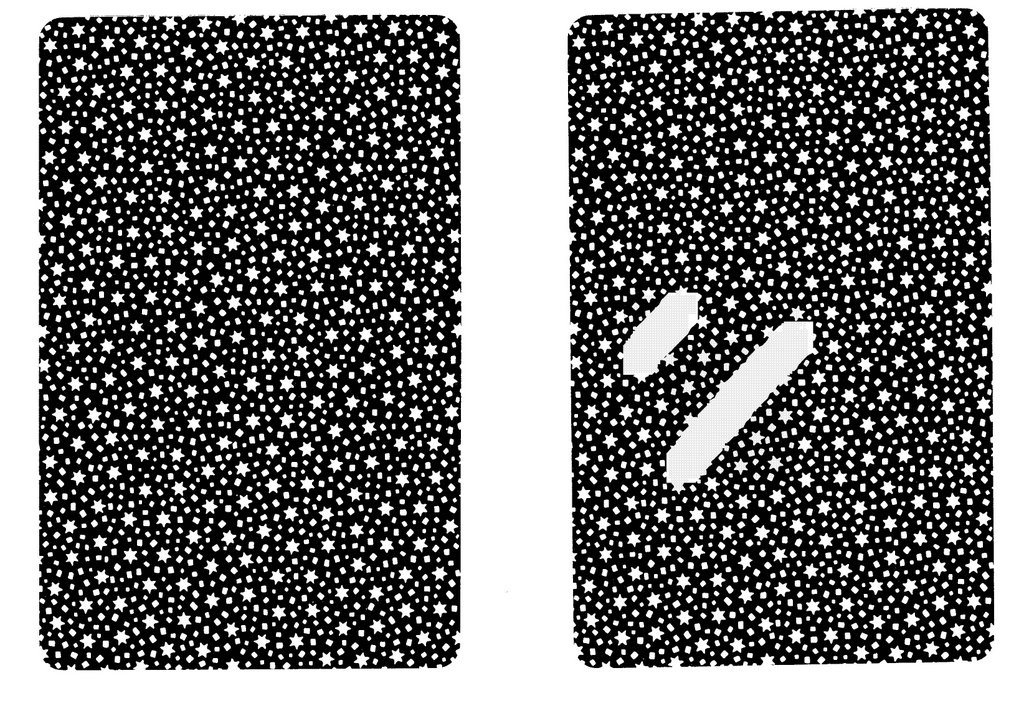
SECRET OF THE CARDS
I remember the moment very clearly. I was at the office of Martin Breese videotaping Basil Horwitz as he demonstrated some of his material for a forthcoming book. This would have been in the mid-eighties.
Basil had dealt some ESP cards onto a table and I was looking through the viewfinder on the video camera. Then I noticed something very odd. I stopped filming, went over to the table and took a good look at those cards. They appeared perfectly ordinary, it was a pack of ESP Cards manufactured by Haines House of Cards in America. So I went back to the camera and looked through the viewfinder again and it was like looking through a pair of magic spectacles because I could see marks on the backs of the cards. I stepped away from the camera and looked at the cards again. To my surprise I could still see the marks.
“Basil, pick up those cards and give them a shuffle,” I said. Basil did, he knew I was up to something but couldn’t figure out what. “Now deal them in a row.” Five cards went face down onto the table. “Now turn the one on the right face up. It’s the star.” He did. And it was. And all the time I’d been standing a dozen feet away from him.
What I’d discovered, quite by accident, is that the Haines’ pack of ESP cards is marked. I’m not referring to the tiny markings at the corners, those are quite well known, but two big broad strokes on the backs that can be read across a room. In fact, here’s the peculiar thing. They can only be read across the room. Go up to the pack, examine the backs of the cards and I promise you you’ll never find those markings unless you know where to look.
Some years later, I mentioned this to magician and mentalist Ray Hyman on the phone, saying only that the Haines cards were marked. It’s a one-way mark, which is how I knew where the Star was on that table. I’d noted that its back was the wrong way up compared to the others. Anyway, Ray was coming to England to appear in a television documentary, and I met him at the airport on his arrival. First thing he did was bring out a deck of Haines ESP cards and ask where the hell the marks where. He’d been examining them on his plane journey and just couldn’t find them. But that’s the beauty of it. Look at the cards up close and it’s impossible to spot them. Put the cards on a table across the room, and they are as clear as day.
Enough of the teasing. The marks are the result of a flaw in the spacing of the tiny stars on the back of the cards. It produces two broad strokes across one end. And you can only see the strokes at a distance. I’ve tried to illustrate the position of the strokes in the diagram (1). Both cards have the marks at the same end, but I’ve highlighted them on the second card. They are impossible to see in the first card because of the reproduction process but if you had the real cards in front of you, you would be able to pick them out. Dig out a pack and try it for yourself.
As soon as you get near the cards, the markings disappear from sight, which means you have to be careful when sorting them into a one-way arrangement. Reading the cards up close is an acquired skill. Reading them from a distance is much much easier.
As for applications, well like names of the Devil, they are legion. Set up a pack in the usual Circle, Cross, Lines, Square, Star order. Have every Star arranged the wrong way and you have a stacked deck you can read across the room. Someone can cut and cut and deal four cards onto the table. You immediately know their order (if no Star appears, obviously you have the other four cards). From here, miracles can be worked.
The best kind of effect is one in which you stand well away from the spectator and the cards. A hands-off routine, possibly working with two spectators sitting at different tables, as they would be if involved in an old Duke University telepathy test. It’s a scenario that gives you a good excuse to use the cards. Have the spectators sit back to back, so that they can’t see each other. You, of course, can see all the cards as they are cut and dealt and you’ll find it easy to bring about remarkable coincidences just by controlling their actions and introducing one or two instances of Magicians Choice. I’ll leave the rest to you.
NOTES: This item was originally contributed to Trevor McCrombie’s online magazine The Centre Tear. As several readers proved, the marking system can be used in a variety of ways. So have fun!
Subscribe to:
Posts (Atom)