Showing posts with label Richard Wiseman. Show all posts

Thursday, November 14, 2024

T. NELSON DOWNS TALKS!

I discovered a little known film of the 1932 SAM Convention in Detroit and wrote about it in my Cardopolis Newsletter. Cardopolis Lab 02 to be specific. I thought it an exciting piece of footage because we get to hear the voices of T Nelson Downs, Nate Leipzig and several other prominent magicians. Someone then republished the information on the Thayer Magic Group without mentioning Cardopolis but adding ‘courtesy of David Britland.’ Which was a complete surprise to me since no one asked me about it. Cheeky devil!

One magician who made magic proud was Thomas Nelson Downs. Here is what was published in Cardopolis Lab 02 together with some additional information about T. Nelson Downs, the King of Koins, one of the greatest manipulators the world has ever seen.
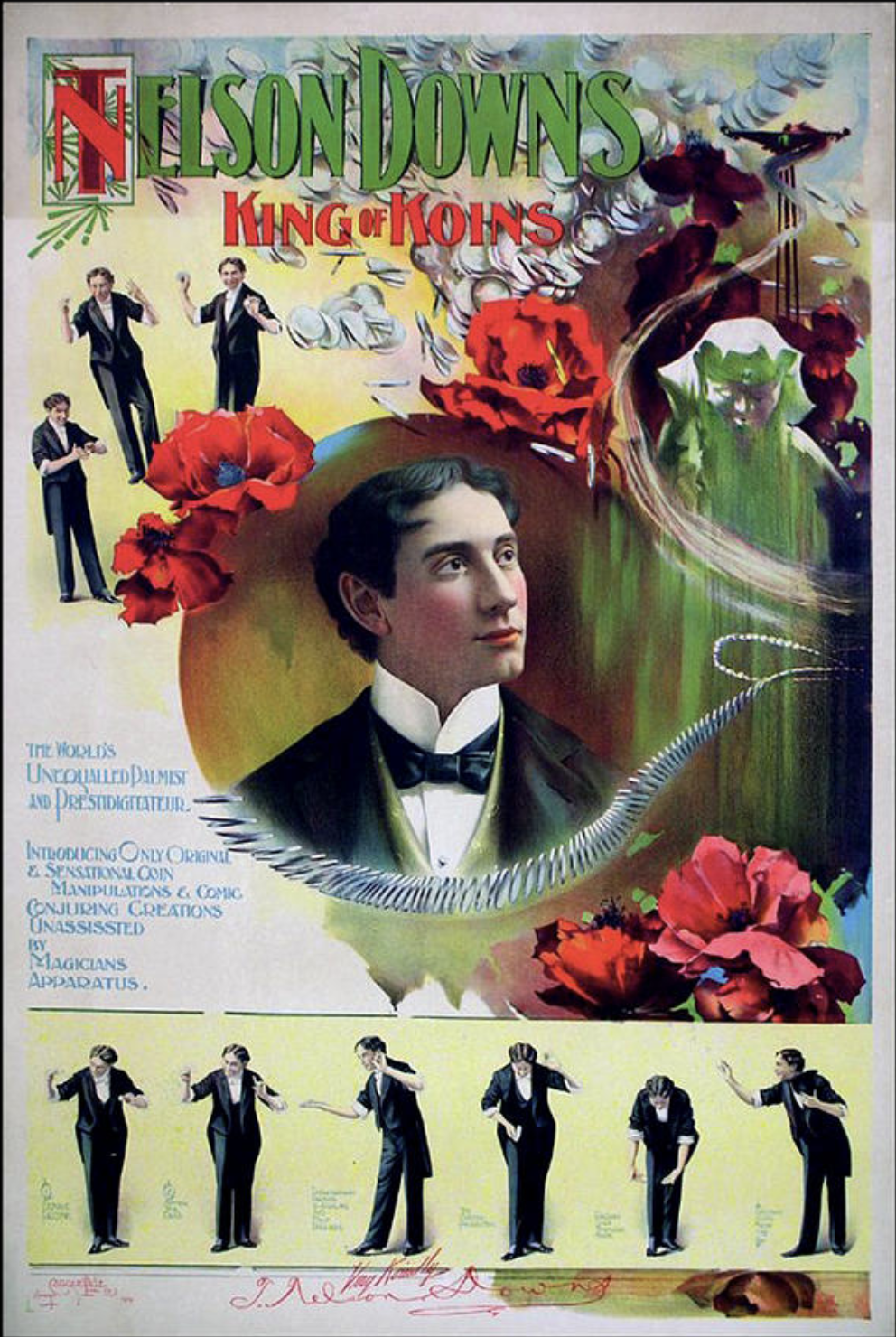

FROM CARDOPOLIS LAB 02

Here’s an interesting magic clip. It’s from the SAM Convention in Detroit, 1932. It shows a rather mischievous Tommy Downs, almost clowning around as he tries to make sure he’s in the movie. Later you’ll see him perform the Coin Star. I’ve never been overly convinced by this trick, but I have to say that Downs has a wonderfully light touch compared to others I’ve seen do it. Makes you realise why he was praised for his coin manipulations. Definitely worth paying attention to.

I do recall discussion as to whether ordinary coins were used for this trick or whether you might cheat and wax one of the coins so it stuck to the fingers. I think the coin on Down’s thumb is, let’s say, firmly placed. Oh, and you also hear Downs talk, which was a surprise for me. Also talking on this film, and performing some cigar manipulation, is Nate Leipzig alongside John Mulholland and Paul Noffke. Noffke demonstrates a little card manipulation.

When you click the link that follows, start your viewing at 01:46:35. The magic segment is at the end of a very long news reel collection. Here is the link at the Historic Films Stock Footage site.


SOME THOUGHTS

Much of what I know about T. Nelson Downs comes from the correspondence he had with Eddie McGuire. I delved into this when writing Phantoms of the Card Table (2003) with Gazzo. Downs was very knowledgeable about card magic, but he became famous for his work with coins. He travelled across the world with his coin manipulation act, an act that was praised as the finest of its kind. It was also copied by other performers, some of them, like Talma Mercedes, making a good job of it.


By 1912 Downs had largely retired from variety and was living in Marshalltown, Iowa when he began his correspondence with Eddie McGuire and became acquainted with the Phantom of the Card Table that was Walter Scott. You can get a sense of his character from the correspondence. He was proud to declare his expertise not only on magic but also cardsharping. He wrote to McGuire:

'I’ve read all the books on Card Sharping and I’ve “been there & helped skin ’em,” and I know from experience that the best thing ever invented for advantage playing at cards is “Second” dealing. It beats all the other devices put together for getting “the coin” in any card game for the following obvious reasons:'

And then went on to list why second dealing, Walter Scott's favoured technique, beats all other sleights when cheating at cards. Downs was exceptionally well-informed, and described riffle shuffle chains of the kind we associate with Charles Jordan and the use of eight perfect dovetail shuffles to bring a deck back to its original order. In the letters he writes of his friendship with Dr Elliott andHoudini. 

Downs and Houdini had been friends since they met at the Chicago World's Fair in 1893, they later worked in many of the same venues across the US. Downs travelled to London in 1899 where his act was very successful and this encouraged Houdini to do the same because one year later, and without a booking to his name, Houdini was in London trying to sell himself as the world's greatest escape artist. They remained in contact for many years, Houdini regularly sending Downs his latest press releases.

On hearing of Houdini's death in 1926, Downs wrote to McGuire: 'I was very sorry to hear of Houdini’s death. Regardless of his faults Houdini was the greatest booster for Magic that ever lived and probably ever will - his early demise will be a great loss to Magic.'


THE LONG NAIL

Downs explained his manipulations in his book Modern Coin Manipulation, published in 1900 while he was still working the act in the theatres. The book contains photographs of Downs’ hands and in them you can see the overly long nail on the little finger of the right hand. There was no mention in the text as to the reason for this oddity. But Willard S. Smith, writing in The Sphinx magazine (October 1950), said, ‘His hands were not overly large and by way of partial compensation he let the nail on his right little finger grow to abnormal length. Perhaps this helped him to backpalm six half-dollars, a feat which he found not at all difficult.’ Looking at the photographs in Modern Coin Manipulation, this might be true.


It's not clear from the photographs in Modern Coin Manipulation whether the nail on Down’s left little finger is also long. I mention this because Downs also used a long nail to maintain a break when performing card magic. See Greater Magic (1945) where Hilliard describes The T. Nelson Downs Speller:

‘I should record here that Mr. Downs makes use of his famous long little finger nail at this point, by inserting it in the break under the Ace of Hearts and then inviting the spectator to cut off a few cards. He holds the pack in such a way that the cut can only be made by the ends and as the spectator takes hold of the cards he tilts the inner end of the eleven pack with his finger nail thus forcing the cut at this point. This is a very useful method of forcing the cut and can be done, even if the performer does not enjoy the use of an elongated horny appendage on his little finger. It is only necessary to hold a break by squeezing a little of the fleshy part of the tip of the little finger in between the two packets, and not to raise the packet perceptibly as the spectator makes the cut.’

Downs refers to a nail break in a letter to Eddie McGuire (November 23rd, 1929) where he gives instructions to hold a break in the deck, adding that ‘I hold this break usually with the L. finger nail.’ It’s not clear whether the ‘L’ means ‘little’ or ‘left.’ Downs also made use of his thumbnail to hide a blob of wax used in a trick and to nick or scrape the edges of cards so they could be located in the deck.


A MAGICAL GIANT

Let’s return to T Nelson Downs and his coin manipulation act 'The Miser's Dream.' There are plenty of accolades from the press about the act, and Downs featured many of them in Modern Coin Manipulation, but the most enthralling account of Downs’ act that I’ve read was by A. J. Essler and published in Top Hat (Issue 5, 1951), the newsletter of the Portsmouth & District Magic Circle.

I have no information on A. J. Essler but his essay is one of a series called Magical Giants of the Past. Essler writes he was around 18 or 19 years old when he saw Downs perform at his local theatre. And that while 30 years may have passed and ‘distance may lend enchantment to the view,’ he says that, ‘Wherever the truth of the matter lies, to me Nelson Downs remains the most outstanding magical performer of my experience.’ Essler’s description, which mentions Downs' voice, continues:

‘Nelson Downs was one of nature’s fortunate beings, in that he possessed all the attributes which make the ideal stage performer. I say nothing at the moment as to his manipulative ability. He had a really fine appearance, and naturally he was perfectly turned out, happiness exuded from him, and perhaps, next to his very great skill with his hands, his truly magnificent voice was his greatest asset.'

‘I have never seen since then anyone who tripped so likely down to the footlights, who seemed to enter upon his (indecipherable faded text) entertaining his audience with such éclat. He seemed to move not to walk: “Ladies and Gentlemen, I will try and amuse you with some tricks in magic, but before doing so, I’ll remove my cuffs, as it is not my intention for to deceive you (notice the odd phrasing: “For to deceive you”), he goes on: “Now may I borrow a hat?” A topper is passed up from the orchestra. “I was going to show you the rabbit trick, but someone said you have seen it before, so instead I’ll tell you the story of a Miser’s Dream.'

‘From this point the classic Aerial Mint, as he reached into the air and caught a silver piece, he conveyed the impression of having actually caught it, sometimes he caught a single piece, at other times a number, then as he took and pushed it through the hat we were certain that it had, in fact penetrated the crown, then his little catchphrase, “Every movement that picture,“ spoken in almost a whisper but this whisper in that wonderful voice could be heard in every corner of the house. The Coin Catching ended, he then proceeded to show a variety of passes, vanishes, productions, the coin passing through the legs, turn over of 90 coins lying on the palm without visible movement of the hand. What an artist? and what perfect enjoyment his act provided he was truly an actor playing the part of a magician.’

When discussing this with Richard Wiseman, Richard asked a good question. Did Downs use music in his act? There’s no mention of music in Modern Coin Manipulation nor any of the press accounts that I’ve seen. But the sound that is mentioned is what one journalist called 'the melodious jingle' of coins as Downs tossed them into a glass or hat or set them tumbling down a coin ladder. When it came to sound, Essler recalled:

‘When Downs was on the stage, you could truly hear a pin drop, there was no intermittent applause, the spectators were too intent to break the silence - and let me say to you young performers, silence indicates attention, let the applause come in its right place, at the end.’

Essler recalled a friend who had also watched Downs. The friend, who ‘disliked all forms of conjuring,’ had unwittingly gone along to the theatre thinking that the ‘Miser’s Dream’ was a theatrical sketch. On meeting the following day, the friend told Essler, ‘I saw one of the finest dramatic performances last night I am ever likely to see, I enjoyed every moment of it.’

At the end of the show, Essler went backstage with several magic buddies and hung out with Downs in his dressing room. ‘He seemed delighted to see us,’ wrote Essler, and asked them to come again and he’d tell them all about the performance he was about to give for some local dignitaries.

‘He showed us everything he could think of in card and coin work, and was quite generous in his praise. One of my friends was really clever with coins and cards, and he had one or two moves that delighted Downs. He was, he said, “Tickled to death with that, I’m sure going to use it, here’s something in exchange."'

The last paragraph of Essler’s essay pays a touching tribute to T. Nelson Downs:

‘There are others who were much more intimate with Downs than I who say that there were better manipulators than he. On that I am unable to offer any decided opinion, I have seen many: Mersano, Allen Shaw, Talma, Fred Harcourt, Cameron, the younger Dobler, and others. They all did excel in some direction, but none had the acting ability, none the sense of timing, none the spirit of sheer joy and none that wonderful voice. No, there was only one King of Koins, and his name was Tommy Downs.’

THE GREATEST BOOK ON MAGIC EVER!

T Nelson Downs stayed at 4 St. Alban's Place, Regent Street when in London. He published the address in Modern Coin Manipulations. It also appears in a series of advertisements he placed in The Sphinx magazine in 1903 and 1904. I discovered this using the Ask Alexander database at the Conjuring Arts Research Centre, a service I can I thoroughly recommend.

Downs was promoting a book to be written in collaboration with British magician G. W. Hunter. Hunter was a successful comedy performer on stage and a pioneer of close-up magic off stage. Max Holden, writing in The Linking Ring (January 1933), praised his card work, with a special mention of Erdnase, saying, 

'Now first of all let me explain that Mr. G. W. Hunter is one of the greatest inventive magicians of all times and Mr. Hunter was one of the first magicians to master the Erdnase book. Magicians used to say it was impossible but Mr. Hunter showed that it was.'

The book Downs and Hunter were planning would have made it the largest book on magic published at that time. The advertisement, headed 'Special to the Fraternity,' is tantalising:

'As I am daily in receipt of many inquiries re our new book, I wish to state briefly that I have collaborated with Mr. G. W. Hunter, and we are at present, and have been for some time, very busy writing what we promise will prove positively the greatest and most up-to-date work ever produced on modern magic. The book will contain, amongst other features, a complete and correct explanation of all the programs, exactly as performed by our most eminent magicians since the time of Robert Houdin to date; including those of Bautier DeKolta,  Anderson, Verbeck,  Jacoby,  Guibal,  Bertram, Hartz, Fox, Hertz, Nix, etc., etc. These, programs will be described with every attention to detail, and in such a manner that any performer desiring to reproduce them will experience no difficulty in doing so.'

'The book will contain about 700 pages, solid matter, most concisely written: there  will be no 'padding' or unnecessary 'patter.' A chapter will be devoted entirely to Handcuff Trix and will contain a biography and sketch of the famous Harry Houdini, written by himself.'

The book was a work in progress and Downs advised not to send any money until it was completed. Unfortunately, the book never appeared.

Wondering what happened to this magnum opus I found a manuscript by G. W. Hunter titled Mystia, which was the name of Hunter's wife. Fergus Roy published this lost manuscript in volume 2 of The Davenport Story: The Lost Legends (2010). Fergus estimates that the manuscript, which is about a 100 pages, was written around 1899. It does contain explanations of programs featured by many famous performers, as mentioned in Downs' advertisement. Was this to be part of Downs' untitled masterpiece? I'll leave that thought with you.


Sunday, October 24, 2021

HOUDINI AND THE SEA MONSTER

Houdini escapes from the belly of a sea monster!  I was a teenager when I first read this sensational tale in Milbourne Christopher’s Houdini: The Untold Story (1969). The book described an event that took place in 1911 after a ‘sea monster,’ sometimes described as a ‘cross between an octopus and a whale,’ was found on the beach near Boston. Local businessmen challenged Houdini to escape from inside the carcass and he accepted. I read several accounts of the stunt, all were vague and none of them gave details of the mysterious creature that had washed up on the shore. This was very annoying because, in addition to magic, I was also thoroughly absorbed by cryptozoological mysteries, and avidly read books on the Loch Ness monster, the Abominable Snowman and dinosaurs that roamed the jungles of the Congo. What the hell was that sea monster?

When Milbourne Christopher referred to the sea monster, he used quotation marks. I confess I didn’t take any notice of them at the time or even realise their significance, an oversight that many chroniclers of Houdini’s exploits have also made. The story is briefly but tantalisingly referenced in many books. Occasionally quotes are used but often they are not. Harold Kellock, in the biography authorised by Houdini’s wife, describes the creature as ‘a sort of crossbreed of whale and octopus.’ He also has the escape taking place offshore with Houdini being lowered into the water  and inside the ‘dark, meaty dungeon.’

Particularly perplexing for me was that none of the Houdini books had a photograph of the ’sea monster’ or, as you might expect, one of the great escapologist standing triumphantly beside it. For a kid obsessed by monsters, that was very irritating. Then along came the Internet.

Houdini's sea monster haunted me for decades but all became clearer in 2011 when Campaign Outsider published a photo of the creature online.

The photo came from The Boston Post (Sept 25th, 1911). Why this photo did not appear against any of the published accounts in magic books is an interesting question. But, following the lead given by Campaign Outsider, and delving into the digital archives of Boston newspapers, here is what I’ve been able to put together about Houdini and the Sea Monster.

On Sunday, August 13th the sea monster was brought into Boston Harbour by the steamer S. S. Prince Arthur. The Prince Arthur made daily trips between Yarmouth, Nova Scotia, to Boston, a distance of some 300 miles. And the creature, openly identified as a giant turtle by the Boston press, who covered just about every aspect of the story, had been harpooned in Liverpool, Nova Scotia, by Captain George DuBois. The Captain said the seven-foot turtle put up quite a fight and that it was a struggle to get it into his small, powered dory boat. The intention seems to have been to take the turtle to Boston where it could be cut up and sold for meat to restaurants, to make turtle soup. Turtle soup was a popular dish at the time. The then President of the United States, William Taft, was said to have hired his chef because of his skill at making this favourite dish.

This turtle did not become soup, a more ignominious fate awaited the poor beast. Instead, it was exhibited as a ‘Sea Monster’ at the Boston pier known as Long Wharf. The creature was now reported as weighing 1,000lbs, and resembled a cross between a seal and a turtle. Some of the press seemed keen to tell their readers that this was more than a turtle. ‘Persons interested in strange forms of life will doubtless make a point of seeing it. To school children it will prove especially interesting.’

It wasn’t long before those interested in zoology became curious about the ‘sea monster.’ Professor Henshaw and his team at the Agassiz Natural History Museum at Harvard College identified the creature as a 500lb a turtle, spargias coriacea, a species that originated in the ‘Southern Waters, near the Caribbean Sea’ and was said to rarely come north. It’s from the family of leatherback turtles.

The professors had the turtle embalmed, possibly for the museum, but somehow it remained on exhibit at  Long Wharf. While the capture of a large turtle might have been rare it was not unprecedented. In July 1906, the Boston Post reported the landing of a ‘monster keel-back turtle in the Georges fishing grounds near Cape Cod. It took fourteen men to pull this nearly eight-foot turtle into the boat after it had been harpooned. Even while wounded its powerful flippers and snapping beak meant it was still dangerous. Rather than try to finish the creature off they let it die on deck. 

The year before Houdini’s escape, 1910, the Boston Sunday Post featured a story about a ‘Giant Turtle’ captured 65 miles off Highland Light, Cape Cod, that was said to weigh over 1,100lbs and was taken to Gloucester for exhibition. Quite a few giant turtles, like the one above, ended up on exhibition. One crew were paid $250 for their dead turtle, the idea being that some prospective Barnum would put it on display. Despite this, newspapers were still fond of portraying their capture as a battle between fishermen and sea monsters. It made a better story than saying they’d harpooned a turtle that was lost having wandered too far north.

One month after the Long Wharf sea monster went on exhibition, the 36-year-old Houdini arrived in Boston to play B. F. Keith’s Theatre. As was his custom, to drum up business for the show, Houdini announced that he would accept challenges from the local townsfolk ‘to furnish any sort of a box, can, package or bag specially constructed with a view to holding him captive, from which he will escape.’ The only stipulation was that he be given 24 hours notice so that the challenge could be advertised in the newspapers.


John F. Masters issued such a challenge on the 25th September. He dared Houdini to escape from inside Long Wharf’s famous sea monster, which was now reported as, ‘weighing more than 1,500lbs, and estimated to be about 500 years old.’ John F. Masters managed the business of the Dominion Atlantic Railway Steamship Company at Long Wharf, the owners of the Prince Arthur, the ship that brought the turtle to Boston and had arranged for its exhibition. More significantly, Masters also worked in tourism and you’ll find his name in many of Nova Scotia’s tourist ads and brochures. The challenge clearly had promotional advantages for Masters, the steamship company and the local area. 

Masters called in other local businessmen to support him, and all got a name check in The Boston Post article announcing the challenge. And this is where we get our only glimpse of the ‘Freak Sea Monster,’ a photograph that clearly shows it is a turtle. A big turtle for sure but not a cross between a whale and an octopus or any other chimeric creature you might imagine when seeing the words ‘Sea Monster.’ The teenage me would have been very disappointed.

Houdini responded to Masters’ challenge. ‘This is the most original challenge I have ever accepted. If you bring your sea monster to the stage of B. F. Keith’s Theatre on Tuesday evening, Sept. 26. 1911. I will submit to the conditions you name.’ One of those conditions was that he have enough ventilation while inside the carcass. ‘As the inside of a fish or turtle is not the most desirable place to be for any length of time.’ 

The challenge actually took place on the afternoon of Tuesday, 26th September. Crowds of people followed the sea monster, ‘an exceedingly evil looking brute,’ as it was paraded through the streets and the one mile distance from Long Wharf to B. F. Keith’s Theatre on Mason Street.

The turtle was on stage when Houdini read out the details of the challenge to a packed theatre. As Houdini was finishing, John F. Masters ‘sprang to his feet’ and asked permission to read a legal document he had drawn up for Houdini to sign before undertaking the stunt. The document stated that as the turtle had been embalmed using arsenic Houdini took all responsibility and relieved the challengers and their heirs for evermore. Houdini took this unforeseen demand in his stride and bravely signed his life away.

This eleventh hour revelation is a small stroke of genius. And I think we can be confident that it was dreamt up by Houdini not Masters. Houdini went off stage to change his clothes and returned wearing ‘blue jumpers, and armed with three handkerchiefs and two bottles of strong perfume.’ He sprayed the perfume inside the turtle. A gang of sea skippers then proceeded to chain and manacle Houdini, the details of which were reported.

‘Houdini was bound hand and foot with handcuffs and leg irons and was then placed inside the big monster. The belly of the monster was then laced tightly with strong chain. The eyelets through which the chain was passed being three inches apart. After being laced in, the chains were locked by numerous locks and then strapped around the monster were more chains which in turn were locked.’

Houdini’s assistants Franz Kukol and Jim Collins were there to place Houdini inside the turtle. ‘It was a tight squeeze.’ Already gasping for breath, Houdini asked them to hurry. Bess Houdini watched from the wings. The turtle was left belly up, ‘so that Houdini could get a little air by pressing his lips against the chains.’ A red curtained cabinet was placed around Houdini and the turtle, and the orchestra began to play.

15 minutes later, Houdini came bounding from inside the cabinet, his hair mussed, and his face drenched in sweat.  The packed audience cheered and the challenging committee congratulated him. Still apparently suffering from his suffocating ordeal, Houdini called for the windows and doors of the theatre to be opened so that fresh air could be let in. Whenever this escape is mentioned, so too is Houdini’s struggle for breath having been almost overcome by the embalming fumes. 

Newspapers reported that Houdini’s escape was much quicker than the three days Jonah spent inside a whale. Before the event was over, Houdini announced that another challenge would be met the next day. Two locals had invited Houdini to escape from a restraint used to incapacitate the insane. This time the escape would be ‘in full view of the audience.’ And so, with the promise of another captivating challenge, Houdini kept his public enthralled.

Two days after Houdini’s escape, the turtle was back at its regular job: ’Sea Monster which challenged Houdini now on exhibition at Long Wharf. Admission 10 cents.’

Houdini and the Sea Monster gives us a detailed insight into how Houdini constructed a challenge, and how not only the press of the day but historians of later years reported it.  Even before Houdini arrived on the scene the turtle was referred to as a sea monster. Houdini and the journalists were often in the same business, selling stories and entertainment. Though I do detect a little more scepticism from The Boston Herald than The Boston Post. Historians while dedicated to uncovering the reality of the past are also susceptible to a little myth making. Better to not look too deeply into the mystery of the sea monster if you want to tell a good story. Oddly, Houdini himself doesn't seem to have made much of his escape from the sea monster. It does not appear to be an event he boasted about. The stunt served its purpose, and was only one of several challenges performed during his engagement in Boston, but perhaps it was something he didn't want anyone digging into. We can only speculate. 

However, the sea monster is a splendid example of a Houdini challenge that is unique to the location. Houdini surrounds the challenge of the unknown with his tried and tested work with handcuffs, chains and locks.  He counters uncertainty be creating a firm base from which to operate. The novel challenge also provides unique staging opportunities. The parade of the sea monster to the venue. The last-minute signing of a document absolving the challengers of responsibility. The possibility of being poisoned and the final call to throw open the doors and windows to let in fresh air.  This is a professional at the top of his game and who knows exactly how to extract the maximum from any performance. He did all this for one show. For Houdini, every stunt brought new opportunities.

Houdini’s greatest talent was his showmanship. The best of his challenges tell the story of a hero who struggles, almost fails and then succeeds, sometimes at great cost. We can find this pattern in some of Houdini’s best-known escapes, like the Daily Mirror Handcuff Challenge where he almost fails, dramatically cuts himself free of his coat and then escapes only to bear the scars for the rest of his life. At least that is how the event has been retold. The sea monster has all those elements and more. It’s a story where myth meets legend, Monster vs Houdini. A battle between man and beast embroidered by the public's imagination. Houdini created stories and played them out on stage. Stories that pitted the human spirit against whatever could be thrown against it. Stories that survive even today, keeping his memory alive and transforming a life into legend.


FINALLY

Giant turtles still find their way north. Just this month one washed up at Cape Cod. Luckily it was pushed back into the waters before any Barnum could lay hands on it. You can read about it here.

If you are interested in Houdini, then do visit Wild About Harry, the incredible blog from John Cox. John has posted a couple of times about this story including some pages from an unproduced movie script about Houdini in which the sea monster makes an appearance.

The photographs of Houdini in this article are credited to the State Library Victoria in Australia, specifically the Will Alma collection. This is a tremendous resource for anyone interested in magic and its history. And you will find it here.

If you are interested in the history of magic, you might want to check out a book I worked on with David Copperfield, Richard Wiseman and Homer Liwag. It's called David Copperfield's History of Magic and is available from 26th October just about anywhere they sell books, including Amazon. David Copperfield has an astonishing collection of Houdini equipment at his museum in Las Vegas and if you ever have the opportunity to visit, grasp that opportunity with both hands. It is simply breathtaking. 


Saturday, June 20, 2020

Invisible Men

Man Becoming Invisible. Photographs Taken As He Vanished. That was the headline in The Illustrated London News (20th January 1934). A series of photographs showed a man dressed in a protective suit and helmet standing inside an open-fronted cabinet. His hands were raised and grasping two metal globes hanging above his head. A switch on a control panel was turned and the man slowly faded away. He had become invisible. Thanks to a little editing magic by my good friend and talented designer Vanessa Viana, we can be witness to that magical moment in science.


The accompanying story in The Illustrated London News laid out the details:

A young inventor, Herbert Winck, claims to have perfected, after seven years’ research, an apparatus which can render a man invisible; and these photographs would certainly appear to bear out his claims. His device is to be used, we are told, in a variety turn; and therefore it is not possible here to explain the mechanism of the apparatus. Dressed in garments which are described as an “electro-helmet” and “spectral mantle,” a man enters a cabinet, open at the front, placed on a brilliantly lighted stage. With both hands he touches contact globes above his head, and an electric current is switched on. Gradually he appears to become transparent, and, as the “anode” rays are strengthened, his body disappears into thin air. He is then tangible but not visible; a touch of the hand, we are assured, will verify his continued presence in the cabinet. This spectacular “act” recalls the famous H. G. Wells romance “The Invisible Man,” though in that fantasy the hero achieved invisibility by chemical and not electrical means. A film, soon to be seen at the Tivoli, has lately been based on that very story; but the remarkable effects which Universal have attained in that are due, of course, to trick photography.

The story came to my attention many years ago through the chatter on UFO forums. UFOlogists, raised on too many episodes of The X-Files, maintain that alien technology has been available on Earth ever since the remnants of crashed flying saucers were stored in Area 51. Invisibility was one of those alien technologies. They pointed to the demonstration given in 1934 as proof that invisibility was a scientific reality. Any magician reading the account of the demonstration would leap to another conclusion. This was a version of Pepper’s Ghost.

Pepper’s Ghost is the name given to a theatrical illusion invented by Henry Dircks and exhibited by 'Professoer' John Pepper at the Royal Polytechnic Institution. It was first used in 1862. As Professor Pepper read portions of Charles Dickens’ ghostly tale The Haunted Man, a translucent ghost walked across the stage. ‘This must really be seen to be appreciated though even when seen the spectator is much as ever at a loss to understand the modus operandi by which a delusion so perfect is brought about,’ said one reviewer.

Pepper and Dircks’ invention became the foundation for a whole genre of stage illusions in which people could be made to appear or disappear or transform in full view of the audience. The mechanics of the illusion, a combination of lighting control and mirror reflection, are still in use today. You can see it in action at the Haunted Mansion ride at the Walt Disney resorts where translucent ghosts dance and fly around the haunted ballroom ballroom.


Let’s get back to Herbert Winck. A few months after his London debut, his demonstration made it into the pages of Popular Mechanics magazine (April 1934). What has began as a publicity stunt for a ‘variety turn’ was gaining scientific legitimacy. Here is the account:

After years of research, a young British inventor claims to have produced an apparatus which can render a man invisible although he still stands before you in the flesh. Operation of the device, which is being used for exhibition purposes, is a closely guarded secret but the man who is to disappear is clothed in what is described as an ‘electro-helmet’ and a ‘spectral mantle.’ In this garb he looks like a deep-sea diver as he stands in a cabinet, open at the front, on a brilliantly lighted stage. With both hands he touches contact gloves above his head and an electric current is switched on. As the current becomes stronger it is claimed that the man seems to become transparent, then gradually vanishes, the feet disappearing first, followed by the rest of the body and finally the head. The subject then is said to be tangible but not visible. Spectators are invited to verify the man’s presence in the cabinet by a touch of the hand, and maintain they can feel he is still there but are unable to see him. Even the eye of the camera does not reveal the secret. 
Photographs taken during successive stages of the vanishing act, show only what the human eye perceives.


Magicians had a little more insight than the popular science magazine. In the May 1934 edition of The Magic Circle’s journal, The Magic Circular, they commented, ‘Thoughts of Pepper perforce arise, but there is nothing in the photographs to suggest this.’ What The Magic Circular didn’t recognise was the name of the inventor, Herbert Winck.

Winck was a magician from Germany, not a British inventor as reported in Popular Mechanics. I don’t know much about him other than you’ll find him mentioned in The Linking Ring magazine and the German conjuring journal Die Magie. It was in The Linking Ring that he sold an effect by Fred Milano. It was called Filmo. First advertised in May 1931 it was followed up by a more detailed an intriguing advert in June 1931. Here it is:


The story of the Invisible Man demonstration was later included in The Wonder World Encyclopedia (1936). The story is brief and begins, ‘Herbert Winck, a young inventor, claims to have discovered a method whereby man can be rendered invisible.’ As with the Popular Mechanics report it gains credibility as a scientific device by virtue of nestling neatly between the story of X-Rays and the invention of Television. Photos taken from The Illustrated London News story illustrate the text.

Herbert Winck wasn’t the only person getting press attention for an invisibility machine. Just two years later two Hungarian (Viennese according to some reports) inventors, Stefan Pribil and Adam Gosztonyi, got a considerable amount of publicity for invisible rays they had devised. Another popular science magazine, Modern Mechanix (April 1936), had a feature on both inventors and their devices. Pribil’s device was a small open fronted cabinet in which objects became invisible. If a packet of cigarettes was placed inside, and the ray activated, the box and wrapping disappeared leaving only the cigarettes visible. A volunteer could also place their hand inside the cabinet and watch it slowly dematerialise. ‘This is no illusion done by some magicians, not trick of mirrors,’ the article assured us. 


Adam Gosztonyi gave a demonstration featuring an even larger open fronted cabinet. A chair was examined and then set in front of a striped background inside the cabinet. A young man sat on the chair. And slowly disappeared leaving the chair in place. ‘If you did not think that you were just seeing things, right off you’d say some invisible wires, or anyway, a cleverly arranged set of mirrors. But you’d be wrong in your guess,’ said Mr Gosztonyi.

It’s Pribil rather than Gosztonyi who gets most of the press if you do a newspaper archive search. It’s unclear what the relationship, if any, the two Hungarians had. And in fact there are press stories that they are rivals with a Harold J. W. Raphael of Modern Traders Ltd in London speaking on behalf of Pribil and threatening legal action against Gosztonyi. 

One year later and it is Pribil who is demonstrating the Invisible Man stunt and offering it to buyers as a novelty window display or entertainment. The Daily Express for April 30th, 1937 has a story by reporter Howard Whitman. Five people, including Howard Whitman, stepped behind a ‘glass screen at a forty-five degree angle in front of us, a plain wall with four silvery lamp brackets behind us, shone light shoot up up at us like footlights. There were a half-dozen spectators in the darkness outside.’ Moments passed and nothing seemed to happen. Whitman said, “I was about to chuckle because all five of us were there just as solid as statues, when a spectator’s voice creaked, ‘They’re gone. They’re vanished completely. Only the chairs left now.’ And minutes later: ‘Look, they’re coming back.’” Whitman then watched the demonstration from the front and saw Pribil’s girlfriend, Ebba Anderson, become invisible, disappearing from the chair she was sitting on. The article concluded with an interesting clue from Whitman: ‘Scientist Pribil made a cigarette case vanish leaving only the cigarettes. “Miracle!” gasped a spectator. And if I hadn’t seen something out of the corner of my eye while I was invisible, I would have gasped “Miracle,” too.’


Pribil said that with enough funding, a thousand pounds, he could make the statue of Eros disappear from Piccadilly Circus. And for ten thousand he could make St Paul’s disappear. Pribil did get £250 from Hungarian screenwriter Akos Tolnay who was living in London. In October of 1937, Tolnay sued Pribil claiming that he was forced to part with the money by ‘fraudulent misrepresentation.’ He said he did not know how the invisibility device operated.

What Whitman saw and Tolnay invested in is clear from the 1939 patents that Pribil filed in Berlin and Canada. The Optical Illusion Apparatus was indeed a transformation illusion using a sheet of glass. The glass was not clear but was tinted. According to Pribil it was this tinted colour that avoided a ghosting effect as the reflected image took over from the real image. Multiple changes were possible by having a rotating chamber in the hidden compartment. What is also unusual is that the hidden room usually seen in this type of illusion is above the volunteers rather than to the side.


It’s surprising how many accounts of invisibility experiments you can find in magic’s literature. In his biography, It’s Fun to be Fooled, illusionist Horace Golden describes how he invented a camouflage method that would render troops and vehicles invisible. It was reported in US newspapers in September 1918, a couple of months before WW1 came to an end. The headline used by the Salt Lake City Herald was, ‘Mystic Goldin Devises Trick to Baffle Hun.’ Goldin said that he had demonstrated his invention to the military and was heading to Washington for full approval:

Brigadier A. P. Blocksom, department commander of the United States army in Honolulu; Colonel Mettler of the ordnance department, and other army officers have inspected the invention. Though they are reticent regarding its value for war uses, Mr Goldin will carry letters from military officials which will pave the way for a thorough investigation of his invention before high officers of the army.
The performer says this his invention is of the camouflage variety and that it can give advantage to allied snipers and machine gunners and completely mystify the Hun. A demonstration of the Goldin device was given in Honolulu and San Francisco and all present went away mystified.

Nothing came of Goldin’s invention, if it ever existed. Goldin died in 1939 and memories of his invention might have died with him were it not for Joseph Dunninger. When WWII came around Dunninger, America’s leading mind reader, referred to Goldin’s previous efforts to help the military and now offered his own services as an expert in invisibility.

In 1939 Dunninger said he would gift the American government a means of camouflaging not soldiers and tanks but battleships. The story got quite a bit of publicity for Dunninger and featured a photo of the apparatus which resembled a model ship in a frame. To demonstrate its effectiveness Dunninger turned on some kind of invisible ray and the ship disappeared leaving behind only a thin silver line.

He said that for a few thousand dollars the apparatus could be applied to any military vehicle; ships, planes and even troops. Dunninger explained, ‘All I can say that it is a piece of apparatus about one tenth the size of a plane which can be applied practically instantaneously and renders the plane absolutely invisible at a distance of 50 feet.’ There’s no report that the US government ever took up Dunninger’s idea. If any Dunninger experts out there have any information about the apparatus, please get in touch.


I wish I knew more about Captain ‘Shrapnel’ Smith, a characterful name if ever there was one. I know about him from a report of The Magic Circle’s Third Collectors’ Day in 1978 where Peter Warlock lectured on the use of the mirrors in magic. There he recalled another ‘Invisible Ray,’ the invention of another Hungarian, Mr. Kallay from Budapest. It was promoted by one Captain ‘Shrapnel’ Smith. This was in April of 1939 and Smith invited members of the Circle to a demonstration of the invisibility ray in action at Stationers’ Hall in London. Peter Warlock, Francis White and John Young attended and watched as a table, vase and the roses it contained disappeared from view. The line made by the angled glass on the carpeting did not escape their attention and a letter to the promoters of the event stating that the invisible ray was no more an old illusion redressed went unanswered.

An addiction to invisibility drove H G Wells’ invisible man mad and there’s a certain madness surrounding the stories of invisibility and magicians. Hungarian inventors, army captains, illusionists and mind readers. None of them people you would expect to be at the forefront of science. But all of them absolutely fascinating. My favourite story of invisibility is one that didn’t get any coverage in the newspapers or science magazines. It took place in the office of paranormal investigator Harry Price and is told in his book Confessions of Ghost Hunter (1936). 

Self-proclaimed inventor Sandy MacPherson, a Scotsman from Houndsditch, arrived at Price’s office with a truck load of mirrors and the claim that using them he could make himself invisible. However, on meeting Price he decided that today he would only make his reflection invisible. Price agreed and MacPherson shut himself in a room with his mirrors and proceeded to set them up in secret. After half an hour he called to Harry Price and said he could enter the room.

When Price walked in he was confronted by the spectacle of a semi-circle of mirrors set around a chair. Sandy was there too and asked Harry to switch off the lights for ten seconds and then switch them back on. When the lights came back on Sandy was sitting on the chair. He asked Price to walk slowly up to the chair and see if he can find his reflection in the mirrors. Price did as directed and had to admit that for a moment he was very surprised. ‘…for a fraction of a second I was genuinely startled. Although the end of the room furthest from the set-up was visible in every detail, the reflection of my Caledonian friend from Houndsditch appeared to be missing. The chair was also invisible, whereas normally, of course, both chair and man should have been reflected.’

It took a moment for Price to realise that what he was seeing was a variation of an old magic illusion. MacPherson, proud of his achievement, asked what Price thought of his ‘psychic gift.’ Price’s response was to pick up the chair, move it six inches and its reflection duly appeared in the mirror.

MacPherson had originally asked for a large fee to cover his demonstration of invisibility. After haggling with Price he settled for the cost of transporting the mirrors from Houndsditch. Harry Price described him as ‘one of the most brazen spellbinders’ he had ever met. A term that could be applied to many of magic’s Invisible Men. 

Brazen spellbinder was also a term you could apply to Harry Price. He deftly trod the line between fact and fiction in his career as Britain's leading ghost hunter. His library, which was one of the finest collections of conjuring literature in the UK, is now housed at Senate House at the University of London. 


About five years ago Professor Richard Wiseman (he's a real professor) told me about a grant available from Google's Making & Science Team to put together some kind of science project. I told him that there was an unproduced illusion of Robert Harbin's that might make for a fascinating experiment in optics. Robert Harbin was a magician and designer of illusions though later in his career he became more known to the public via in interest in origami. In the world of magic he is famed for many inventions but chiefly in taking traditional stage illusions and making them work under cabaret conditions. One of the magical effects he had tackled was invisibility.

The illusion I had in mind was called The Transparent Man and was published in Something New in Magic under Harbin's real name of Ned Williams. This was in 1929, five years before Winck gave his exhibition. The effect is that anyone from the audience can stand inside a glass cabinet and be rendered invisible. It was a very interesting idea. The problem was that Harbin had never built a full scale model of the illusion. The model he constructed was only nine inches high. I mentioned to Richard that perhaps this was an opportunity to find out if the trick worked. In a scene that echoed that of Sandy MacPherson and his truckload of mirrors, Richard Wiseman set up a chair in the middle of his lounge, surrounded it with sheets of reflective perspex, turned on a light and, well, you can see what happened in the following video. Enjoy.


Thursday, April 28, 2016

DAVID BERGLAS - NOTHING IS IMPOSSIBLE

Fans and followers of David Berglas will be pleased to know there is now a website devoted to the life of this legendary performer. It is an ongoing project developed by Professor Richard Wiseman and the University of Hertfordshire. There you will find interviews with David about his early years together with many photographs from his archive. To quote the introduction for the website:

For decades 'International Man of Mystery' David Berglas amazed the world with a series of seemingly impossible stunts. Now in his 90s, David lived through some of the most dramatic and traumatic events of the twentieth century. Psychologist Professor Richard Wiseman (University of Hertfordshire) recently recorded David describing some of his early experiences, including living in Germany during Hitler's rise to power, attending the 1936 Berlin Olympics and working as a postwar Nazi hunter.

You'll find plenty of interest about the man who has created some of the most impossible effects in magic. Go here.